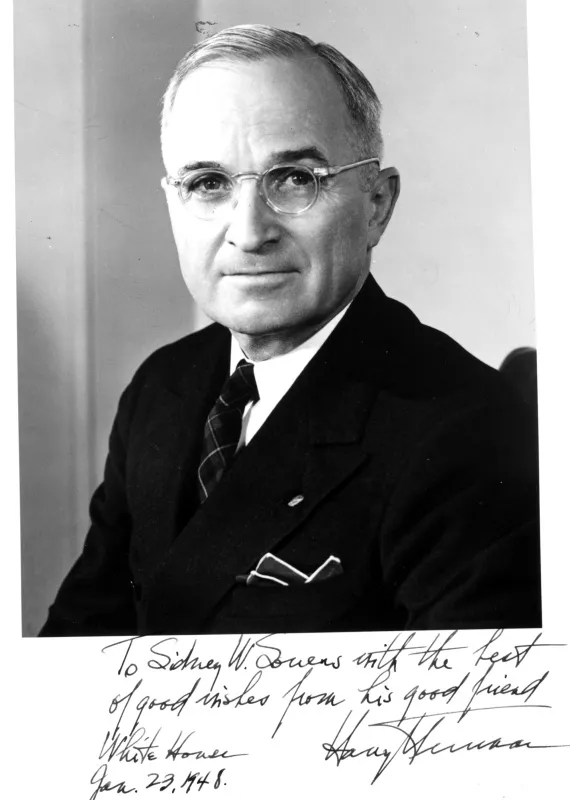
The prediction had become so comfortable that some observers stopped treating the election as an open contest. Thomas E. Dewey, the Republican governor of New York, campaigned cautiously. His opponent had no such luxury. Truman needed people to reconsider a presidency that inflation, strikes and political defeats had made unpopular.
A party coming apart
The Democratic nomination offered Truman less security than it usually offered an incumbent. Two breakaway candidacies threatened to peel votes from opposite ends of his coalition. Strom Thurmond's States' Rights Democrats defended racial segregation and rebelled against the national party's civil rights program. Henry Wallace's Progressives opposed the administration's confrontational approach to the Soviet Union.
These were fights over policy, not just personalities. Truman asked Congress for civil rights legislation in February. On July 26, he signed Executive Order 9981, establishing a policy of equal treatment and opportunity in the armed forces. That commitment did not instantly integrate every military unit, but it gave the campaign argument a concrete presidential action behind it.
Truman also had to answer for the difficult transition from war production to a civilian economy. Republicans had taken both houses of Congress in 1946. The president's domestic proposals repeatedly stalled. By 1948, he turned that frustration into his main line of attack: voters should judge the Republican congressional record alongside the Republican presidential candidate.
The work behind the comeback
From September 6 through October 30, Truman traveled about 22,000 miles and delivered 275 speeches, according to his presidential library's chronology. A train gave the campaign a moving platform. The stops brought a sitting president to communities that could easily disappear inside national opinion surveys.
The speeches were combative, but their political logic was practical. Organized labor had reasons to resent the Taft–Hartley Act, which Congress passed over Truman's veto in 1947. Farmers had reasons to favor price supports. Black voters and white liberals could weigh his civil rights program against the segregationists who had abandoned him. Local Democratic organizations still knew how to get their voters to the polls.
None of those groups voted as a single body. Together, however, enough of them sustained the New Deal coalition to make the expected Republican victory disappear. Dewey's restraint left Truman room to set the argument. The incumbent kept naming interests and grievances while his challenger tried to look safely presidential.
Election night, then the morning
Truman cast his ballot in Independence with Bess and their daughter Margaret beside him. Photographer Vernon Galloway recorded the family at the ballot box. Elsewhere in town, young supporters rode in an election parade with a Truman publicity portrait attached to their car. The confidence in those pictures was local and personal; the national result remained unsettled.
The returns eventually gave Truman about 24.1 million popular votes to Dewey's 22 million. He won 303 electoral votes, Dewey 189 and Thurmond 39. Truman's share of the popular vote fell short of an outright majority, a useful reminder of how a decisive Electoral College result can emerge from a divided electorate. Democrats also regained control of Congress.
On November 5, Truman and Vice President-elect Alben Barkley arrived back in Washington. Abbie Rowe photographed them waving their hats at Union Station. A military band and crowds greeted their return to the White House. The president who had been treated as a temporary occupant now had an election victory of his own. The campaign had given him a stronger claim to govern, and a fresh opportunity to find out how much of his program Congress would actually accept.
Cover photograph: Abbie Rowe, National Park Service / Harry S. Truman Library & Museum, 199961. Public domain.