The earthquake generated a tsunami that entered the Tagus estuary and struck the waterfront. Fires spread through the damaged city and burned for days. Lisbon's catastrophe was a sequence of disasters, each making escape from the others more difficult.
A disaster larger than one city
The familiar name “Lisbon earthquake” can make the event sound more local than it was. Destruction extended along the Portuguese coast and into Spain and North Africa. The tsunami traveled across the Atlantic, with observations recorded as far away as the Caribbean. Lisbon became the catastrophe's best-known setting, but it was only one part of the affected region.
Modern estimates commonly place the earthquake around magnitude 8.5 or greater. There were no instruments to record it in 1755, so researchers must reconstruct its size and source from accounts of shaking, damage and sea movement. Different models propose different offshore faults. A precise modern-looking number can conceal how much interpretation lies behind it.
The death toll presents a similar problem. Estimates vary widely because records were destroyed, reports disagreed and some totals describe Lisbon while others cover a much larger area. Tens of thousands died across the disaster zone. Choosing a single exact figure would suggest a certainty the surviving evidence does not provide.
Saving the city, including its papers
King José I's minister Sebastião José de Carvalho e Melo, later known as the Marquis of Pombal, directed the response and reconstruction. Food, shelter, the removal of bodies and the restoration of authority could not wait for a final architectural plan. The state had to function while much of its capital lay broken.
One small episode survives in the records of Portugal's national archive. The tower at São Jorge Castle that housed the royal papers collapsed, but the documents escaped the fires. On November 6, the minister authorized archivist and engineer Manuel da Maia to build a wooden shelter for material recovered from the rubble. Preserving government meant saving records as well as opening streets.
Da Maia, Eugénio dos Santos, Carlos Mardel and other military engineers helped shape the rebuilt lower city. Wider, regular streets and more systematic blocks replaced much of the old pattern. The new Praça do Comércio faced the river where the royal palace had stood. Reconstruction gave the government an opportunity to impose an urban order that would have been difficult to create piecemeal.
Asking what had actually happened
The response also included an attempt to collect comparable observations. A questionnaire sent through church authorities in 1756 asked about the time and duration of the shaking, damaged buildings, deaths, changes in the sea and rivers, aftershocks and fires. The questions were practical. They turned scattered experiences into evidence that could be compared across places.
Abroad, letters and learned papers circulated accounts of the disaster. John Michell's investigation, read to the Royal Society in 1760, treated the earthquake as a physical event whose causes and effects could be examined. Such work did not instantly create modern seismology, but it helped move explanation toward the systematic study of observations.
Ruins on paper
Other responses were philosophical and artistic. Voltaire's poem on the Lisbon disaster, published in 1756, challenged comforting claims that suffering necessarily belonged to a benevolent order. The argument drew its force from crushed bodies and ruined homes, rather than from an abstract puzzle alone.
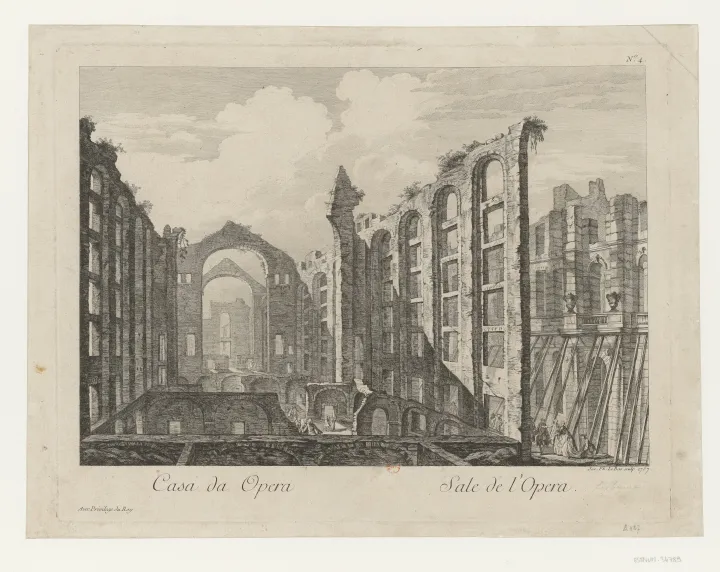
Jacques-Philippe Le Bas's 1757 prints offered a different way of looking. They showed recognizable churches, a square and the opera house after destruction. These are composed works of art, not photographs or literal records of the earthquake in progress. Their ruined walls preserve something the reconstruction could not: a sustained view of the city between the catastrophe and the new streets taking shape around it.
Cover image: Jacques-Philippe Le Bas, 1757 / Bibliothèque nationale de France, département Estampes et photographie, btv1b53274779w; public domain.