The meeting helped turn a small Genevan initiative into a movement of national relief societies. It also chose a common sign for volunteer medical personnel: a white armband bearing a red cross. The legal promise to protect the wounded and their carers would require another conference, and another year.
From Solferino to Geneva
Henry Dunant had seen the aftermath of the Battle of Solferino in northern Italy in June 1859. Thousands of wounded men needed help that the available medical services could not supply. His account, published in 1862 as A Memory of Solferino, described the suffering and proposed an organized response.
Dunant wanted relief societies established in peacetime, with trained volunteers ready when fighting began. He also wanted governments to agree on protection for the wounded and those caring for them. Compassion might bring people to a casualty's side. It could not, by itself, provide supplies, transport, preparation or recognized standing with an army.
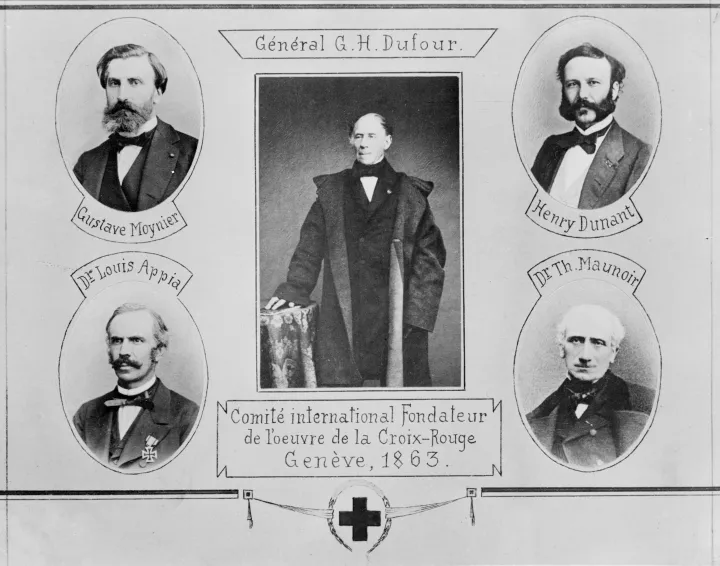
The Geneva Society of Public Welfare took up the proposals. A committee of five first met on February 17, 1863: Dunant, Gustave Moynier, General Guillaume-Henri Dufour, and the physicians Louis Appia and Théodore Maunoir. That meeting is the founding date of the body later known as the International Committee of the Red Cross. October's conference marks a further step, rather than the sudden creation of everything at once.
Ten resolutions, with work attached
The international meeting ran from October 26 to 29. Its first resolution called for a committee in each country to assist army medical services when needed. The national committee could establish local sections, but it would remain responsible for directing the work.
Preparation occupied a central place in the plan. Committees should gather material assistance and train medical volunteers during peace. In wartime they would support their own armies, arrange premises for casualties and, when necessary, seek help from committees in neutral countries. Volunteers sent to a battlefield required military consent and would operate under military command.
This was a way of supplementing army medicine, not of creating an independent force free to go wherever it wished. The resolutions dealt with upkeep, organization and communication because those details would determine whether volunteers could be useful. For the time being, correspondence between the national committees would pass through Geneva.
A sign was not yet a treaty
The red cross on a white armband gave the volunteers a shared identifying mark. A doctor or helper needed to be recognizable quickly and at a distance. The conference also recommended that governments recognize the neutrality of medical facilities, medical personnel, the wounded and civilians who came to their aid.
A recommendation did not bind a belligerent government. In August 1864, a diplomatic conference converted the project into the first Geneva Convention. Twelve states signed the agreement on August 22. Its protections gave the developing relief movement a legal foundation that private resolutions could not supply.
The surviving portraits and papers therefore belong to several moments: the committee's creation, the argument made in Dunant's book, and the subsequent treaty. The essential work of October 1863 was to agree on an organization that could exist before an emergency. Volunteers would have a committee to join, training to undertake, supplies to obtain and a recognizable emblem to wear when the call finally came.
Cover photograph: ICRC Audiovisual Archives, V-P-HIST-00113 / Wikimedia Commons; CC BY-SA 4.0.