
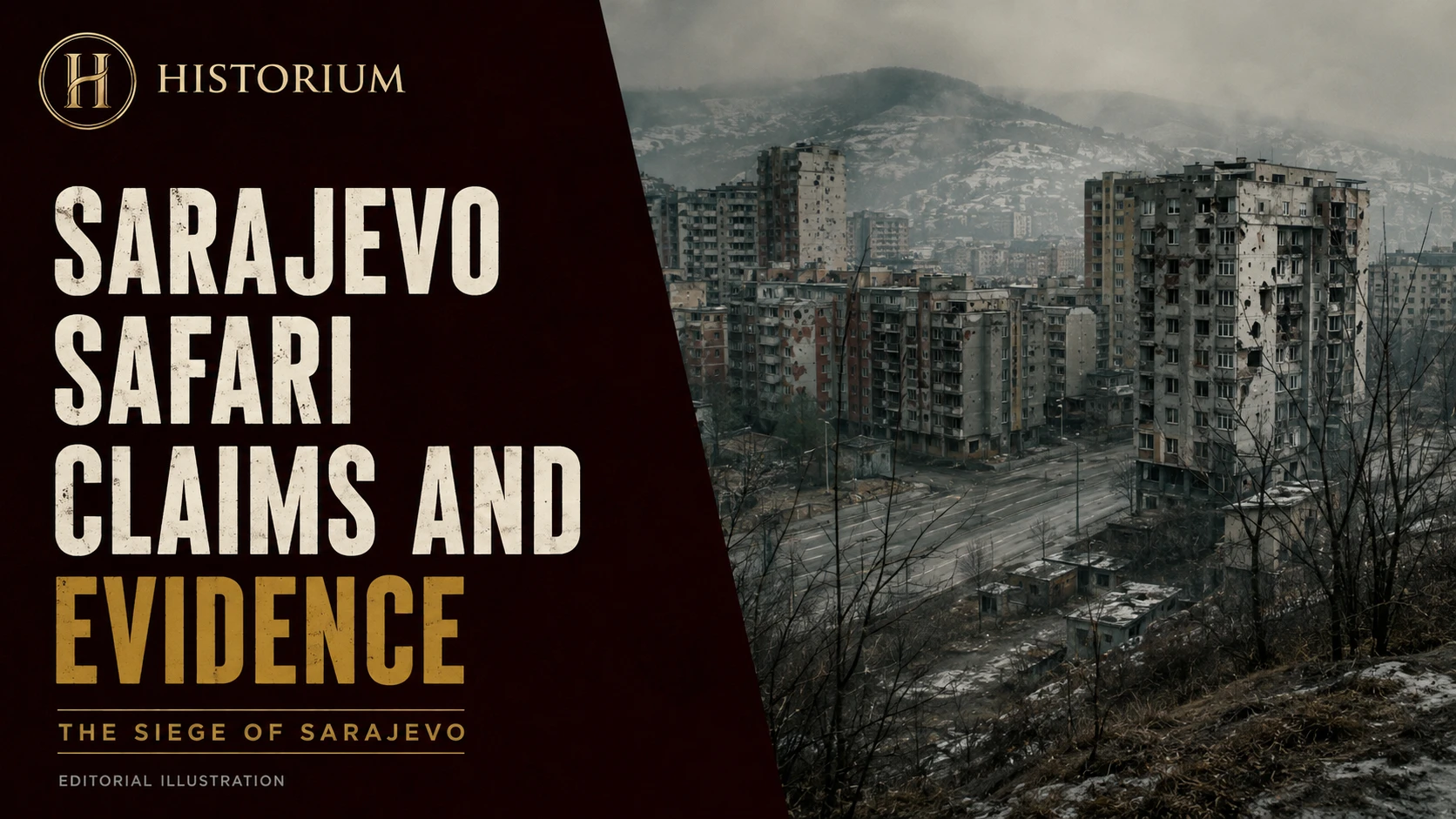

The phrase Sarajevo Safari describes an allegation of extraordinary cruelty: that wealthy foreigners paid for access to positions around besieged Sarajevo so they could shoot at civilians. It is the subject of Miran Zupanič’s 2022 documentary and subsequent demands for investigation. It must be distinguished from a separate, extensively documented fact: civilians in Sarajevo were deliberately subjected to a campaign of sniping and shelling.
Understanding this story requires reading several kinds of evidence together. A judgment establishes what a court found proved. A witness statement records what someone said they experienced or learned. A documentary assembles an argument. Each can matter, but they do not establish the same thing.
The City Behind the Allegation
During the Bosnian war, Sarajevo’s geography exposed residents to fire from surrounding heights and positions within the city. By September 1992, the Bosnian Serb Army’s Sarajevo-Romanija Corps had virtually encircled the city; much of Sarajevo remained under the control of the Army of Bosnia and Herzegovina. The ICTY’s Galić case summary describes both that military setting and the vulnerability of civilians moving through it.
The danger reached into activities necessary for survival. Witnesses described attacks on people using public transport, visiting markets, tending gardens and attending funerals. Children were targeted while playing or walking. Residents changed routines, reduced movement and used improvised barriers. These adaptations could not make ordinary life safe. The court record gives substance to the familiar image of people running across an exposed street: an everyday journey could become a calculation about whether it was possible to cross at all.
What the Sarajevo Trials Established
In its December 2003 judgment against Stanislav Galić, the trial chamber’s majority found that attacks from Sarajevo-Romanija Corps territory formed a campaign intended to terrorize civilians. Its conclusions followed the examination of testimony, particular incidents and the wider pattern of attacks. The judgment identified hundreds of civilians killed and thousands injured during the period under examination. These are findings about a defined case and period, not a complete casualty count for the siege. Read the trial judgment, paragraphs 582–600.
Galić’s initial sentence of twenty years was increased to life imprisonment on appeal on 30 November 2006. His successor as corps commander, Dragomir Milošević, was also convicted of crimes arising from the campaign against Sarajevo civilians; his sentence was reduced on appeal to twenty-nine years in November 2009. Galić’s appeal judgment and the Milošević case summary provide the outcomes.
Those convictions should not be presented as convictions of foreign “safari” participants. They concern the responsibility of particular commanders for specified crimes. Attaching a later allegation to a genuine war-crimes judgment does not automatically establish that allegation.
The Film and Its Specific Claim
Zupanič’s Sarajevo Safari brought the alleged presence of paying foreign shooters before a wider public. The producer, Arsmedia, identifies it as a seventy-five-minute documentary from 2022, written and directed by Zupanič, and records its AJB DOC Sarajevo premiere on 10 September 2022. The producer’s account describes the film’s claim that wealthy outsiders paid substantial sums to shoot at residents of the besieged city.
The filmmaker’s statement also emphasizes the lives of people permanently affected by sniper bullets. That perspective matters: the story concerns survivors and murdered civilians as well as the motives attributed to unidentified visitors.
The production page is a primary source for the film’s authorship, release and stated argument. It is not an independent judicial confirmation of the conduct alleged. Historium’s short video and this article discuss that allegation; they should not be confused with Zupanič’s feature documentary or its production credits.
An Earlier Witness in the Courtroom
Relevant testimony predates the documentary. On 22 February 2007, during the trial of Dragomir Milošević, John Jordan was cross-examined about people he described as “tourist shooters.” He said he had seen individuals whose clothing, weapons and apparent unfamiliarity with their surroundings distinguished them, in his assessment, from local personnel. Local men appeared to be guiding them around known sniper positions. The exchange appears on transcript pages 2695–2696.
Jordan then stated a crucial limit: he had not seen those individuals fire a shot. His description of their appearance and movements was an observation; identifying them as paying shooters was an interpretation. Preserving both parts of the testimony makes it more informative than quoting the allegation alone.
A publicly filed version of Jordan’s witness statement, paragraphs 47–48, further separates what he saw from what he had heard. It describes strangers with expensive hunting rifles and recounts information he said he received from contacts about wealthy foreigners paying to shoot. The statement again says he did not witness them shooting.
What the Evidence Can—and Cannot—Answer
Jordan’s account provides a concrete lead with a date, a witness and an accessible record. It gives readers something more substantial to examine than a repeated claim without a source. At the same time, being present near a firing position does not, by itself, identify a payment, a victim or the person who fired a particular weapon.
Those are separate questions. Who arranged access? What independent records corroborate a witness’s recollection? Can a visitor be reliably identified? Does evidence connect that individual to an attack? A compelling account of the broader siege cannot supply missing answers about a particular participant.
This distinction also guards against collective blame. Evidence about a military unit or an alleged visitor should remain attached to the people and conduct it concerns. Nationality is not a substitute for evidence of individual involvement.
From Public Allegation to Reported Investigations
An official City of Sarajevo announcement dated 26 September 2022 states that then-mayor Benjamina Karić had filed a criminal complaint following the documentary and called on the prosecution to investigate. This establishes that a complaint was made; it does not establish the guilt of the people described in it.
Later procedural developments require similarly careful attribution. On 10 February 2026, N1 reported a statement given to Fena in which Bosnia and Herzegovina’s prosecutor’s office said its war-crimes department was handling the case and had contacted Italian prosecutors and the International Residual Mechanism for Criminal Tribunals.
On 17 June 2026, ANSA reported that Milan prosecutors described evidence seized during a search concerning a suspect in the alleged sniper trips. These are dated news reports about investigative activity, rather than judgments establishing the allegations. This article does not infer a conviction from them or claim to provide a complete, continuously updated account of the proceedings.
Keeping the Victims in the Story
The word “safari” risks making the alleged visitors the center of attention while reducing residents to an anonymous background. The courtroom record offers a different starting point: people trying to travel, find food, care for relatives and continue living in their city. Their suffering does not depend on the outcome of a later inquiry into foreign participants.
A responsible account can acknowledge the established campaign against civilians while examining the additional allegation with care. Neither task cancels the other. Doubts about a particular witness’s inference cannot erase documented attacks; the reality of those attacks cannot turn every subsequent claim into a proved fact.
The lasting value of revisiting Sarajevo Safari lies in bringing the questions back to identifiable evidence and individual responsibility. That means keeping the film’s argument, the witnesses’ observations, the reported investigations and the courts’ findings visible as distinct parts of the historical record.