
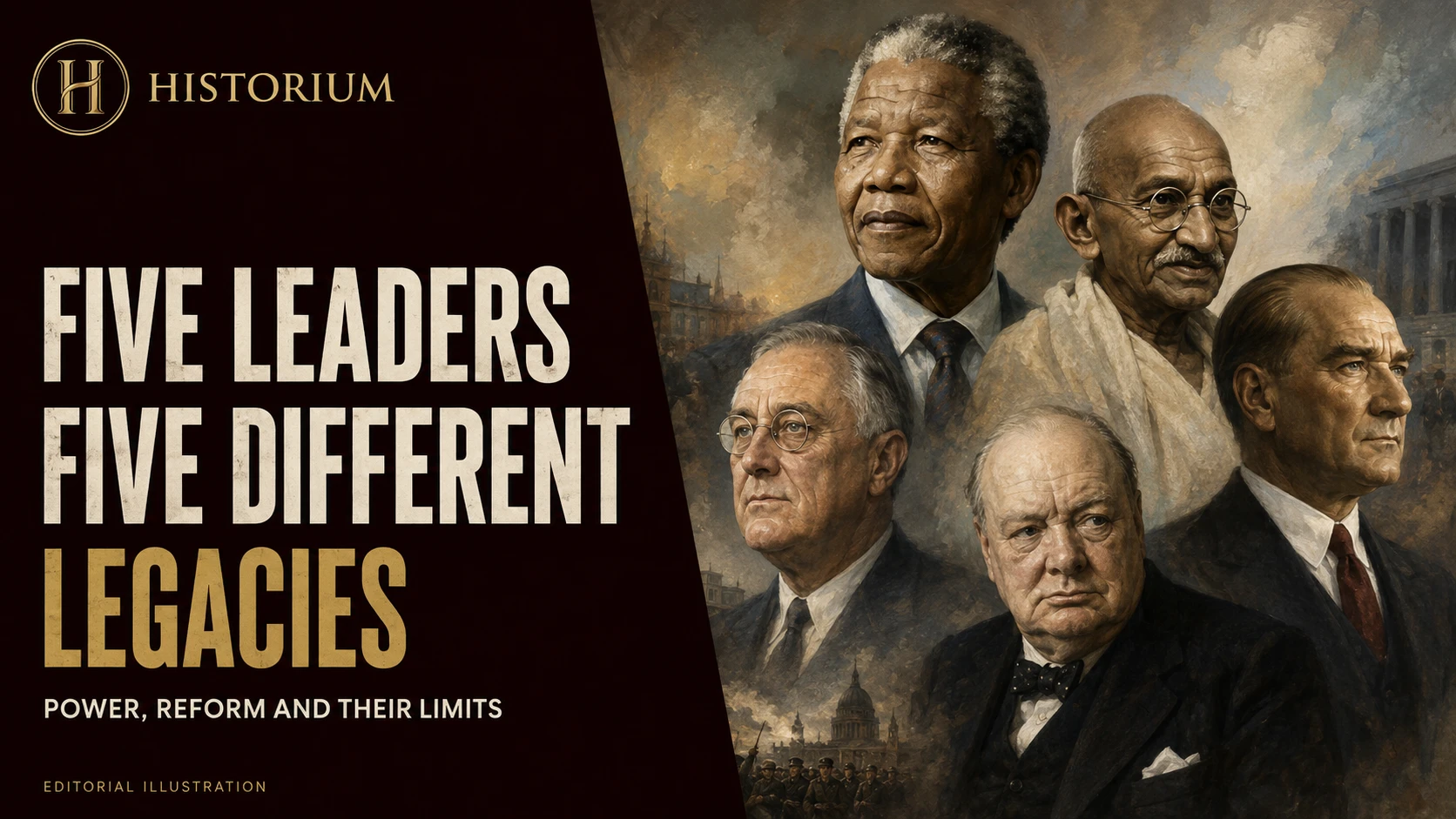

Nelson Mandela, Mohandas Gandhi, Franklin D. Roosevelt, Winston Churchill and Mustafa Kemal Atatürk appear together in Historium’s video about five leading political figures. This is an editorial selection. There is no objective historical league table in which these five occupy universally agreed positions.
Even the word leader covers different kinds of authority. Leading a liberation movement, governing through an economic crisis and directing a state at war require different tools. Comparing the five becomes more useful when the questions are explicit: whose political participation expanded, which institutions changed, what methods were used, and who remained excluded or suffered harm?
The examples below focus on identifiable decisions and their limits. They are starting points for assessment, rather than complete biographies or a claim that individual personalities alone explain historical change.
Nelson Mandela: Democratic Transition and Its Unfinished Work
Mandela’s importance rests partly on the transition from apartheid to democratic government. The Nelson Mandela Foundation’s biography records his participation in negotiations after his release in February 1990, the April 1994 election and his inauguration the following month. It also records his decision to leave the presidency in 1999 after one term. Taking office and relinquishing it belong in the same account of his leadership.
Negotiation required political organization and agreement among people who had been adversaries. Remembering that collective work avoids treating democracy as a gift that one celebrated individual could deliver on his own.
The Foundation’s visitor guide presents reconciliation and nation building alongside the difficulty of transforming a society structured by apartheid. It acknowledges the resilience of inherited social and economic patterns. Constitutional change did not automatically redistribute opportunity or remove material inequality.
Mandela’s record therefore invites two distinct judgments: the achievement of a democratic transition and the incomplete work of social transformation. Recognizing the first does not require pretending that the second was finished when his presidency ended.
Mahatma Gandhi: Mobilization Beyond Government Office
Gandhi’s example shifts attention from executive office to political mobilization. The Sabarmati Ashram’s history connects his social and political work to the community he developed there. On 12 March 1930, he left the ashram to begin the march to Dandi against the colonial salt law.
The campaign made an everyday necessity a focus of resistance. Its significance for thinking about leadership lies in the connection between a recognizable grievance, disciplined action and public participation. It illustrates how a movement can challenge authority without first controlling the institutions of government.
His influence nevertheless had limits. The ashram’s life chronology records communal violence, his work in Noakhali and Bihar, and his response to renewed violence in Calcutta around independence in 1947. His presence and appeals did not prevent partition or the bloodshed surrounding it.
Those events resist a simple story in which moral authority produces the intended result. Gandhi’s efforts against communal violence remain part of his record, while the violence itself demonstrates that even a prominent movement leader could not command all the forces mobilized during the end of empire.
Franklin D. Roosevelt: Public Protection and State Coercion
Roosevelt’s presidency offers a concrete example of expanding the federal government’s social responsibilities. The 1935 Social Security Act created a framework for old-age benefits and unemployment compensation, alongside other forms of assistance. It made economic insecurity a continuing public responsibility rather than only an individual or charitable concern.
The original law also shows why a reform should be examined at the level of its provisions. Agricultural labor and domestic service in a private home were excluded from the employment covered by its old-age insurance definition. A landmark expansion of protection was therefore not universal coverage.
Wartime policy exposes a more severe failure. Roosevelt’s Executive Order 9066, issued on 19 February 1942, authorized military exclusion that enabled the forced removal and incarceration of Japanese Americans. The National Archives explains the consequences for people displaced from their homes and deprived of liberty.
These records demonstrate the need to evaluate policies individually. The capacity of a government to provide greater economic security does not excuse its use of executive authority to violate civil rights. Admiration for the New Deal cannot substitute for scrutiny of wartime coercion.
Winston Churchill: Wartime Leadership and Imperial Commitments
Churchill’s wartime reputation is inseparable from Britain’s resistance to Nazi Germany in 1940. Yet the physical setting of that leadership reveals a larger organization. Imperial War Museums’ War Rooms chronology records the first meeting of his War Cabinet in the underground Cabinet Room on 29 July 1940 and the communications infrastructure supporting wartime decisions.
Speeches were another instrument of leadership. IWM’s account of Churchill’s wartime words places the famous June 1940 addresses alongside contemporary reactions, including criticism as well as admiration. Their later iconic status should not be mistaken for an audience that responded with one mind.
His political commitments also conflicted with the aspirations represented by Gandhi. In a March 1931 speech on India, Churchill defended British imperial rule and opposed concessions to Gandhi. His argument used racial and religious generalizations to present continued British authority as necessary.
Resistance to Nazi domination and support for colonial domination thus sit within the same political career. An assessment centered on Britain’s wartime survival will differ from one centered on Indian self-government. A useful comparison makes that difference visible instead of assuming that one perspective resolves the other.
Mustafa Kemal Atatürk: Republican Reform and Political Limits
Atatürk’s leadership involved remaking the state and its institutions. Türkiye’s Ministry of Culture and Tourism biography identifies the proclamation of the republic in 1923, abolition of the caliphate and unification of education in 1924, adoption of a new civil code in 1926, and introduction of the Latin-based Turkish alphabet in 1928.
These changes affected law, schooling and public administration. They offer specific grounds for discussing the scale of his reform program, rather than describing modernization as a single achievement with no institutional content.
Republican reform did not establish durable multiparty competition during his lifetime. The Atatürk Research Center’s account of the Free Republican Party describes Fethi Okyar’s opposition party in 1930 and its dissolution that November. The brief experiment exposes the limits of political pluralism in the period.
A historical evaluation must therefore keep institutional transformation and restrictions on opposition in view together. The breadth of a reform program and the freedom to contest the people directing it are separate measures of political leadership.
What the Comparison Actually Measures
These examples produce no defensible numerical winner. They instead reveal competing measures: participation, social protection, resistance to aggression, institutional change and the treatment of dissent. A judgment should state which measure it values and still account for evidence that complicates it.
That approach leaves room to recognize consequential achievements without turning any leader’s reputation into an exemption from criticism. It also restores movements, legislatures, officials and ordinary participants to a history too easily reduced to five faces.