
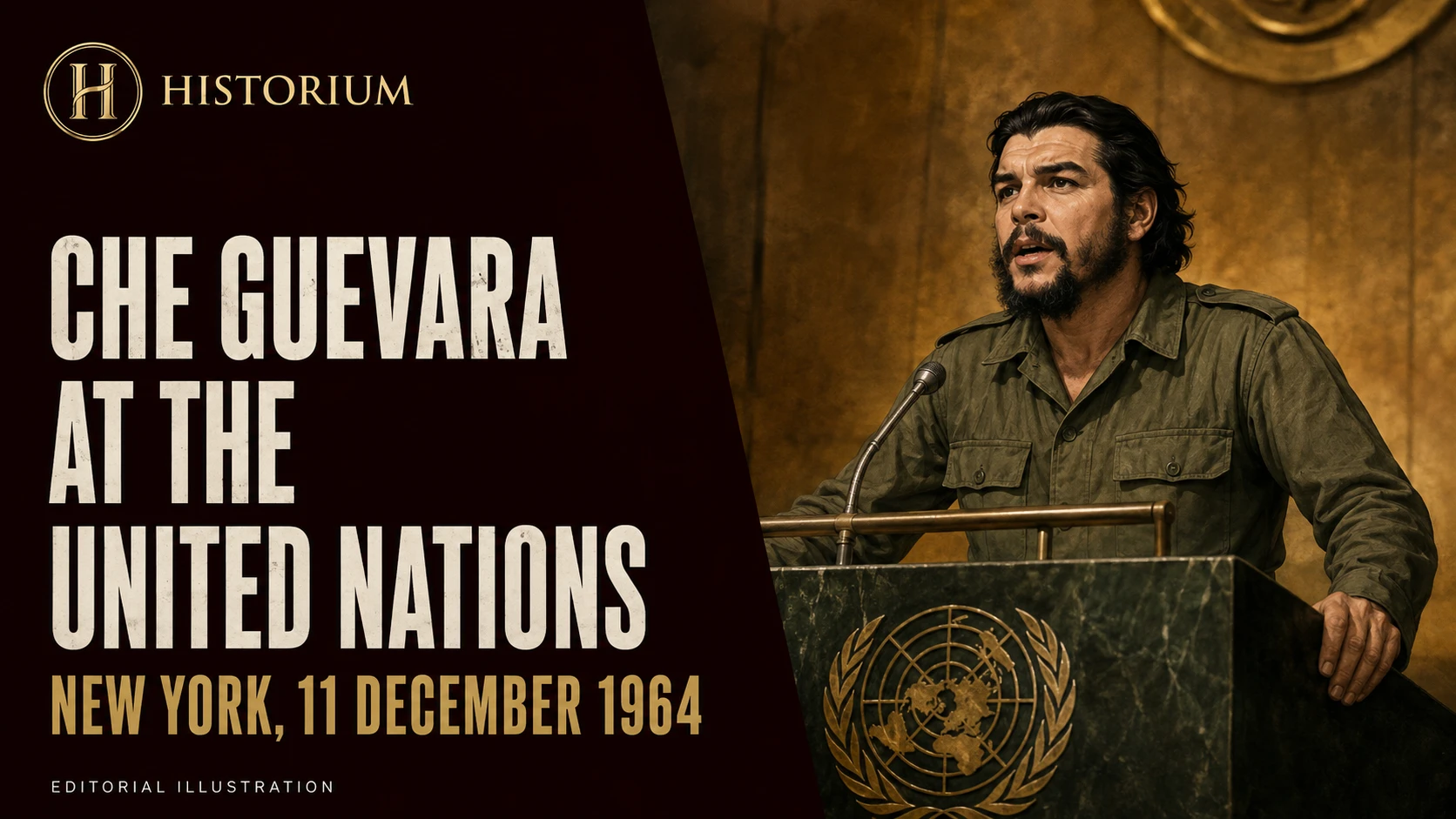

On 11 December 1964, Ernesto Che Guevara addressed the United Nations General Assembly as Cuba’s representative. The UN identifies its surviving film with the nineteenth session’s 1299th plenary meeting. That date and setting matter: the footage records an official diplomatic intervention, delivered in Spanish, rather than a speech made during a guerrilla campaign. The UN’s film page establishes the occasion.
The familiar image of Guevara at the microphone can obscure the practical purpose of the appearance. He was presenting Cuba’s position to other governments. Reading the address alongside diplomatic records helps distinguish that public argument from the international circumstances surrounding it.
What Guevara Was Arguing
In the General Assembly meeting record, Guevara connected Cuba’s experience to anticolonial struggles and the position of poorer countries in the world economy. He argued that peaceful coexistence should protect smaller states as well as govern relations between major powers. He also defended Cuba’s sovereignty and challenged the economic relationship between countries exporting primary commodities and industrialized markets.
These were the Cuban representative’s claims and proposals. Their presence in an official transcript establishes that they were made; UN publication does not turn them into findings endorsed by the organization. The speech should therefore be introduced with verbs such as argued, accused and defended, especially when it describes other governments’ motives or responsibility.
The Failed Invasion Behind Cuba’s Security Claims
The confrontation with Washington had a recent military history. The Kennedy Library’s account of the Bay of Pigs traces the invasion plan to the Eisenhower administration and explains Kennedy’s subsequent authorization. On 17 April 1961, a force of Cuban exiles landed in Cuba with CIA support. Castro’s forces defeated the invasion within days.
Its failure did not end American efforts to destabilize the Cuban government. The library also describes Operation Mongoose, which included sabotage and other covert activity. This history helps explain why another attack was a concrete concern for Havana. It does not, by itself, validate every accusation Guevara made or settle questions about the Cuban government’s own conduct. Context explains the stakes without deciding all the arguments in advance.
After the Missile Crisis
By December 1964, the world had also experienced the Cuban Missile Crisis. The State Department’s historical account describes the secret Soviet-Cuban agreement to place nuclear missiles on the island in 1962, partly to deter another invasion. American reconnaissance discovered missile installations that October, and Kennedy announced a naval quarantine.
The settlement involved Soviet removal of the missiles and an American assurance against invading Cuba. A separate, secret American commitment concerned removing Jupiter missiles from Turkey. The confrontation brought the two nuclear powers dangerously close to war, but its resolution did not produce normal U.S.-Cuban relations.
For an audience hearing Guevara two years later, sovereignty, weapons and foreign intervention were consequently immediate diplomatic questions. Remembering the crisis also prevents a misleading reading of the UN appearance as an isolated rhetorical performance. Cuba’s relationships with Washington and Moscow formed part of the conditions in which its representative spoke.
A Private Contact During the Same Visit
A different perspective appears in a U.S. memorandum dated 17 December 1964. It records Senator Eugene McCarthy briefing officials about a meeting with Guevara the previous day at journalist Lisa Howard’s New York apartment. McCarthy believed Guevara wanted to signal interest in trade and American recognition. That was McCarthy’s interpretation, not a formal Cuban proposal reproduced in the document.
The memorandum also reports continuing disagreement. According to McCarthy’s account, Guevara acknowledged that Cuba trained revolutionaries and intended to continue. He defended the absence of free elections by saying the revolution had not fully developed. American officials expressed concern about the political consequences of further contacts.
This record is valuable precisely because it is a mediated account: a senator reported a conversation, and an official recorded the briefing. It is neither a verbatim transcript nor evidence that an agreement followed. It shows that public confrontation and exploratory personal contact could occur within the same visit.
The Algiers Speech Was a Different Event
Guevara’s address to the Second Economic Seminar of Afro-Asian Solidarity in Algiers belongs to 24 February 1965. In that separate speech, he argued that socialist countries should help finance development and criticized trade conducted on terms he regarded as perpetuating unequal exchange.
Combining passages from Algiers with the December UN footage without identifying the change of date creates a false composite. The two addresses can be compared, but neither should supply an invented transcript for the other.
Watching the UN material with its date, audience and diplomatic setting in view makes the historical episode more intelligible. The record preserves an influential revolutionary’s argument while leaving readers responsible for examining its assumptions, omissions and consequences.