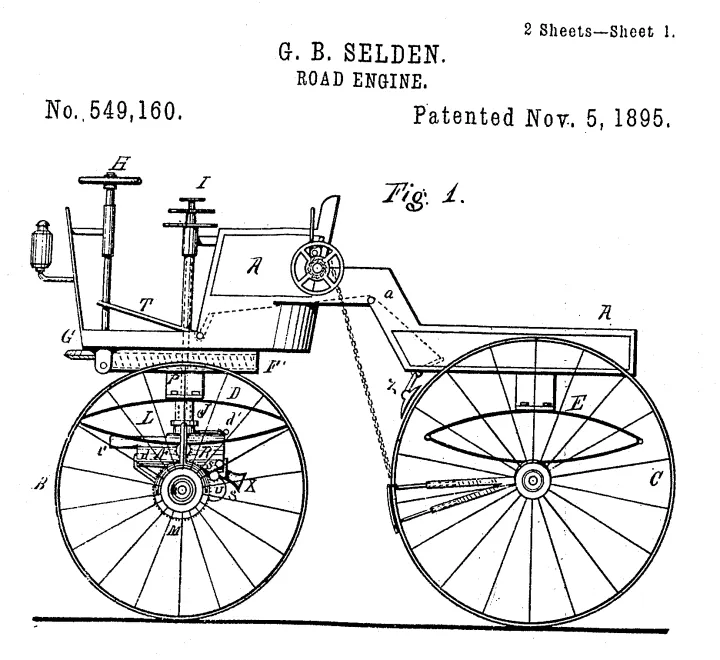
Selden did not put a new production car on sale that November. He obtained a document that would allow him and his business partners to demand payment from people who did. The distinction between inventing a workable vehicle and claiming a combination of mechanical elements became the heart of one of the early automobile industry’s longest fights.
A machine described on paper
A Rochester patent lawyer with a serious interest in mechanics, Selden had considered the problem of a lightweight engine for road transport in the 1870s. His design adapted the principles of George Brayton’s compression engine. He combined that engine with a broadly described vehicle chassis, steering and transmission arrangements.
The Smithsonian preserves a small patent model dated 1879. A model and drawings could establish a claim without showing that a full-sized machine had succeeded on the road. Selden delayed the application’s progress until 1895, when the prospect of gasoline automobiles made the claim commercially attractive. A patent filed too early could lose much of its useful life before there was an industry from which to collect royalties.
Permission to make an automobile
The Association of Licensed Automobile Manufacturers, usually shortened to ALAM, enforced the Selden interests’ broad reading of the patent. Manufacturers who joined the licensing arrangement paid royalties. Dealers could display signs announcing that their cars were licensed under the patent. A technical document had become part of the commercial landscape, visible to buyers as well as engineers.
An advertisement published in The Motor World in 1903–1904 gives the arrangement a harder edge. It addresses manufacturers, importers, dealers, agents and users of gasoline automobiles. The reach of the warning matters: the dispute could influence not only who built a car, but who would risk selling or buying it.
Henry Ford applied for a license in 1903 and was refused. He went ahead with automobile production and became the most visible opponent of the licensing system. ALAM sued. Ford cast the fight as resistance to an automobile trust, a useful public identity for a manufacturer trying to establish himself.
Old vehicles enter a new courtroom
The litigation required more than arguments about dates. Machines had to be examined. A Selden motor buggy completed in 1907 was built as evidence for the case; it was not a surviving road car from 1877. Ford also brought his own early work into the dispute. In 1910, he took his 1896 Quadricycle to New York as evidence during his appeal.
Ford ultimately prevailed in 1911. The appellate decision did not simply declare that Selden had invented nothing. It interpreted the patent narrowly, limiting it to the modified Brayton-type engine described by Selden. The Otto-type engines used in the commercial automobiles at issue fell outside that construction. The broad royalty claim lost its force.
November 5 therefore marks a patent grant with consequences far larger than the vehicle sketched on its pages. The case shows how an emerging industry could be shaped by paperwork, licensing and the precise meaning of an engine design. Selden had seen possibilities early. That did not give him ownership of every later machine that turned those possibilities into transport.
Cover image: George B. Selden / United States Patent Office, patent 549160; digitized patent drawing · Public domain