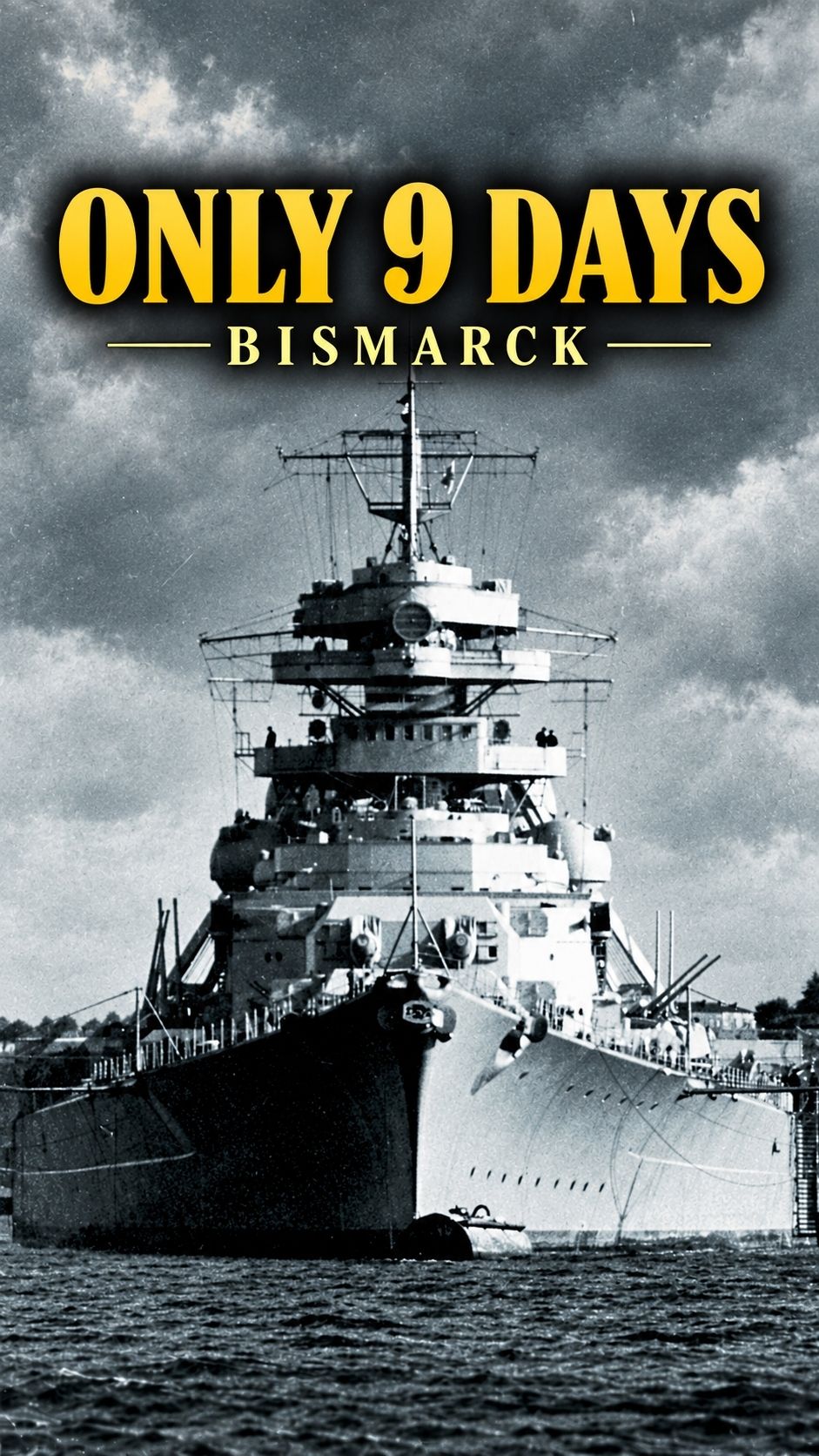
Bismarck is remembered as one of the most famous battleships ever built. Its name has become almost inseparable from the image of the great surface warships of World War II: enormous guns, heavy armor and a brief, violent existence in the North Atlantic.
What makes the story unusual is how little time Bismarck actually spent at war.
On May 19, 1941, the German battleship began its first combat operation. By May 27, it was lying at the bottom of the Atlantic.
Nine calendar days had passed.
In between came the destruction of HMS Hood, a damaged fuel system, a massive Royal Navy pursuit, an attack by obsolete-looking biplanes, a jammed steering system and one of the most heavily armed naval confrontations of the Second World War.
A Battleship Built for the Atlantic
Bismarck was not simply large by the standards of 1941. At deep load, its displacement approached 50,000 tons. The ship carried eight 38-centimeter — roughly 15-inch — main guns mounted in four twin turrets. During trials it had reached more than 32 knots, remarkable speed for a battleship of its size.
Its main guns could throw 1,700-pound shells more than 20 miles. Beneath them sat a secondary battery of twelve 15-centimeter guns, along with a substantial anti-aircraft armament.
For Britain, however, the most important feature of Bismarck was not the thickness of its armor or the size of its guns. It was what the ship could do if it reached the Atlantic shipping lanes.
Britain depended on merchant traffic for food, fuel, raw materials and military supplies. A fast battleship operating alongside the heavy cruiser Prinz Eugen had the potential to force convoys to scatter, divert escorts and consume Royal Navy resources far beyond the number of merchant ships it might actually sink.
That was the purpose behind Operation Rheinübung.
Bismarck and Prinz Eugen were to break into the Atlantic and attack Allied shipping.
Operation Rheinübung Begins
The operation started on May 19, 1941.
Bismarck and Prinz Eugen moved north through Scandinavian waters before attempting to reach the Atlantic through the passages between Greenland and Iceland. British reconnaissance aircraft spotted the German ships near Norway, and the Royal Navy began moving forces into their path.
The heavy cruisers HMS Suffolk and HMS Norfolk took up positions around the Denmark Strait. Their job was not necessarily to fight Bismarck directly. They needed to find it, maintain contact and allow heavier British warships to close in.
By the evening of May 23, the German force had entered the Denmark Strait.
Suffolk and Norfolk found them and began shadowing from a safer distance.
Elsewhere, two British capital ships were racing toward the same stretch of ocean: HMS Hood and the new battleship HMS Prince of Wales.
The Battle of the Denmark Strait
Shortly before dawn on May 24, the two forces found each other.
HMS Hood was more than just another Royal Navy warship. For years, the battlecruiser had been one of the most recognizable symbols of British sea power. Alongside it sailed Prince of Wales, a brand-new battleship that had entered service before all of its technical problems had been fully resolved.
At roughly 05:35, the British ships closed to engage.
The opening minutes were confused. The British initially concentrated on the wrong German ship before correcting their fire. Bismarck and Prinz Eugen, meanwhile, focused on Hood. Surviving German photographs taken from Prinz Eugen show Bismarck firing across the Denmark Strait as British shells crashed into the sea around it.
Then came the moment that changed the entire operation.
A German salvo struck Hood. A catastrophic explosion erupted around the aft section of the British ship, almost certainly involving its magazines. Hood broke apart and disappeared beneath the sea within minutes.
The loss was an enormous psychological shock in Britain.
One of the Royal Navy’s best-known ships had effectively vanished during a battle that had only just begun.
Bismarck Had Won the Battle — but Lost the Mission
The destruction of Hood made Bismarck look almost invincible.
It was not.
Prince of Wales had managed to hit the German battleship with its 14-inch guns. At least two of those hits caused important damage. One opened Bismarck to flooding forward; another contributed to a serious fuel leak and contaminated fuel stores with seawater.
Photographs taken from Prinz Eugen after the battle show Bismarck sitting noticeably lower at the bow.
That damage changed everything.
Bismarck had been sent into the Atlantic to attack Allied merchant shipping. A commerce raider with leaking fuel and reduced endurance could no longer perform that mission effectively.
The raid was abandoned.
Prinz Eugen was eventually detached to continue operating independently, while Bismarck turned southeast toward occupied France. Brest offered repair facilities and a route back into German-controlled waters.
The battle that had produced Bismarck’s greatest victory had also forced it to give up the very operation it had been sent to carry out.
The Royal Navy Hunt
After Hood was lost, stopping Bismarck became an overriding British priority.
Warships were redirected across the Atlantic. Aircraft carriers joined the search. Cruisers continued shadowing whenever possible.
Bismarck was not helpless during this period. It still had speed, firepower and a chance of reaching France.
In fact, the British briefly lost contact.
During the darkness of May 25, Bismarck managed to slip away from its shadowers. For hours the Royal Navy was uncertain about the ship’s position and initially searched in the wrong direction.
The German battleship was heading for France.
On the morning of May 26, a Catalina flying boat finally found it again. The aircraft was operated by RAF Coastal Command, with U.S. Navy Ensign Leonard B. Smith among the crew. The sighting placed Bismarck hundreds of miles from Brest — close enough that the Germans still had a realistic chance of reaching protection from German aircraft and coastal forces.
The Royal Navy needed to slow the ship down.
Its best opportunity was HMS Ark Royal.
The Swordfish Attack
The aircraft that ultimately decided Bismarck’s fate looked almost absurd beside the battleship.
The Fairey Swordfish was a fabric-covered biplane whose design belonged visually to an earlier generation of aviation. It was slow, open-cockpit and apparently unsuited to attacking one of the most modern battleships in Europe.
Yet on May 26 it became the most important aircraft in the Atlantic.
The first strike from Ark Royal went badly. Swordfish crews mistakenly attacked HMS Sheffield, a British cruiser that had been sent ahead to shadow Bismarck. The torpedoes missed, and several of their magnetic detonators proved unreliable.
The aircraft returned to Ark Royal, were rearmed and went out again.
At 19:10, fifteen Swordfish launched for another attempt.
They attacked in poor weather, flying extremely low over the sea and approaching Bismarck from different directions. German anti-aircraft gunners threw up intense fire, but no Swordfish was lost during the attack.
Several torpedoes struck the battleship.
One hit near the stern.
It wrecked the steering gear and jammed Bismarck’s rudders.
The Engines Still Worked. The Guns Still Fired.
This is perhaps the most remarkable part of Bismarck’s final night.
The ship had not lost propulsion.
Its engines still functioned. Its main guns remained capable of firing. The hull had not suddenly become incapable of floating.
But the battleship could no longer reliably choose where it was going.
The damaged rudders forced Bismarck into an uncontrollable course. Engineers and divers spent hours trying to solve the problem. The crew attempted to free the steering system and explored other ways of controlling the ship.
Nothing worked.
Royal Navy accounts describe Bismarck steaming in circles as its pursuers closed in. By late evening, the German command itself reported that the ship was no longer maneuverable.
A battleship capable of more than 30 knots had effectively become trapped in the Atlantic.
The Final Battle
The British ships arrived on the morning of May 27.
HMS Rodney and HMS King George V opened fire at around 16,000 yards and rapidly closed the distance.
Bismarck returned fire, but the situation was hopeless. The ship had endured days of combat, pursuit and constant alert. Its steering was crippled, its crew exhausted and the Royal Navy could now dictate the engagement.
British shells systematically destroyed Bismarck’s ability to fight.
Main gun turrets were knocked out. Fire spread through the ship. The superstructure was devastated.
By around 10:00, Bismarck’s 15-inch guns were no longer operating effectively. British ships continued firing from increasingly close range before breaking off the gun action. The cruiser HMS Dorsetshire then launched torpedoes against the crippled battleship.
German survivors also reported that scuttling measures were taken aboard Bismarck as the ship’s situation became hopeless. Naval History and Heritage Command accounts describe a battleship already reduced to a burning wreck by British gunfire and torpedoes before being scuttled by its surviving crew.
At approximately 10:37 on May 27, Bismarck disappeared beneath the Atlantic.
More than 2,000 men were aboard. Only a little over one hundred survived.
Why Bismarck Became a Legend
Bismarck did not have a long operational career.
It did not spend years moving between theaters of war. It did not fight a long sequence of campaigns. It never carried out the sustained Atlantic commerce-raiding operation for which it had sailed.
Instead, almost everything associated with the ship happened within a matter of days.
It broke into the Atlantic.
It destroyed HMS Hood.
It was damaged by Prince of Wales.
It became the target of a huge Royal Navy pursuit.
It disappeared temporarily.
It was found again.
A slow biplane torpedo bomber crippled its steering.
And the following morning it was destroyed.
That compressed timeline is a large part of why the sinking of Bismarck remains one of the most recognizable episodes in World War II naval history.
The ship represented the promise of battleship warfare at its most dramatic — armor, enormous guns and speed — while its destruction demonstrated how vulnerable even the most powerful surface warship could become once aircraft, reconnaissance and a coordinated fleet were brought against it.
Was Bismarck’s Career Really Only Nine Days?
The phrase requires one important distinction.
May 1941 was not Bismarck’s first time at sea. The ship had undergone trials and training before Operation Rheinübung.
What began on May 19 was its first and only combat operation.
Counting May 19 through May 27 inclusively gives nine calendar days.
That is the striking fact behind the legend: one of the most famous battleships ever built became an icon of naval warfare during a combat career measured not in years or even months, but in days.