
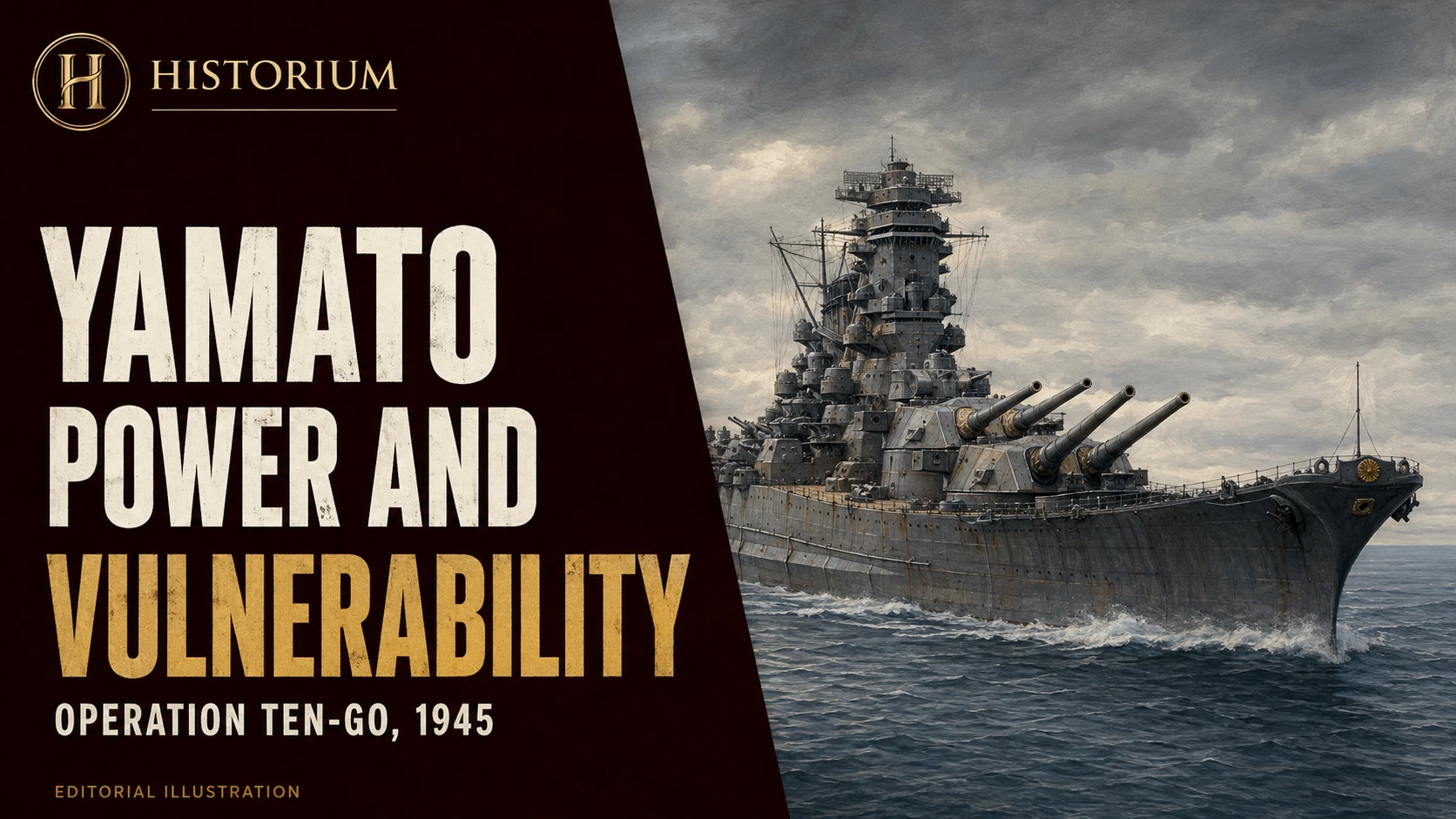

On 7 April 1945, American carrier aircraft sank Yamato before it could reach Okinawa. Alongside its sister Musashi, it belonged to the largest battleship class ever completed. Its destruction is often presented as a contest between a giant ship and relatively small aircraft. The more revealing question is why such a valuable ship was sent into a situation its enormous weapons could not resolve.
Size and firepower describe a vessel’s capabilities. They do not guarantee intelligence, air protection, fuel, freedom of movement or a realistic objective. Yamato’s final voyage brought the gap between those things into unusually sharp focus.
What Made Yamato So Large?
The Yamato Museum’s technical summary gives a length of 263 metres, a standard displacement of 65,000 tons and nine 46-centimetre main guns in three triple turrets. It records completion at Kure on 16 December 1941. Those guns and the structure supporting them belonged to a design built around an exceptionally heavy main battery.
The displacement figure needs its qualifier. Standard displacement and fully loaded displacement describe different conditions; they are not interchangeable measurements. Likewise, the longest ship is not necessarily the heaviest, and an aircraft carrier is not a battleship merely because it shares an immense hull or a battleship’s original construction plan.
That distinction makes comparisons more useful. A list mixing a battleship’s standard displacement with another vessel’s loaded displacement produces a misleading ranking, even if each individual number was copied accurately.
A Mission Directed at Okinawa
The Naval History and Heritage Command’s account of the final sortie describes the surface force’s intended mission: reach the invasion area, attack American transports and beach the surviving ships so their guns could continue firing. Yamato departed on 6 April with the light cruiser Yahagi and eight destroyers. Senior officers questioned the operation before carrying it out.
The National Museum of the U.S. Navy’s Operation Ten-Go overview places this movement within the wider Japanese effort to disrupt Allied forces at Okinawa, including mass kamikaze attacks. The surface force was one component of that effort. It was not sailing toward an arranged duel against an equivalent American battle line.
Its destination imposed the central problem. Reaching the transports required crossing waters within range of American carrier aircraft. The ships’ main guns could threaten targets they reached, but those guns could not require enemy aircraft to remain at a distance or compel American commanders to offer a surface engagement.
Detection Removed the Remaining Advantage
The operation did not achieve surprise. The naval command history describes intercepted Japanese communications and submarine contact reports that alerted American commanders to the force’s movements. Whatever secrecy surrounded planning in Japan, the ships’ passage was being followed.
A photograph taken from a USS Yorktown aircraft shows Yamato maneuvering under attack on 7 April. The catalog identifies both the subject and the photographic source. Such images establish that the battleship was observed from the air during the engagement; they also give a visible record of its attempts to evade attack.
They cannot, by themselves, reveal every decision on the bridge or establish a complete tally of hits. Smoke can conceal damage, the camera records only an instant, and a caption may reflect what was understood when it was written. Photographs become stronger evidence when read alongside action accounts and ship histories.
Flooding Defeated the Fighting Platform
Bombs and torpedoes attacked different parts of the ship’s ability to fight. Damage above the waterline could disrupt weapons, communications and personnel. Underwater damage threatened buoyancy and stability. The size of a main gun mattered little if the ship carrying it could no longer remain upright.
The official history of USS Bunker Hill describes the destruction of Yamato and several accompanying ships by American aircraft. It records thousands of deaths aboard the battleship and identifies a catastrophic explosion as it sank, probably involving ammunition in a magazine. Keeping that qualification is preferable to treating a spectacular image as proof of every internal event.
The loss was therefore both a military outcome and a human catastrophe. Men occupied the compartments that machinery diagrams render as neat spaces. A technical account explains vulnerability; it should also acknowledge the people who had to respond to fires, flooding and orders as that vulnerability became fatal.
Three Ships That Should Not Become a False Ranking
Historium’s related naval stories include Shinano and HMS Barham, but placing them beside Yamato does not make them the world’s three largest battleships. Shinano was begun as another Yamato-class hull and completed as an aircraft carrier. The U.S. naval account of its loss records its sinking by USS Archerfish on 29 November 1944.
HMS Barham was not the world’s third-largest battleship. Royal Museums Greenwich’s surviving plan identifies it as a Queen Elizabeth-class battleship. A Royal Naval Association historical note describes displacement of roughly 33,000 tons, well below later American ships such as the 45,000-ton Iowa-class battleships. The differences are much larger than rounding conventions.
Read Historium’s separate accounts of Shinano’s first voyage and sinking and the filmed destruction of HMS Barham. Each concerns a different ship, military role and sequence of events. Their losses make a comparison of vulnerability possible without inventing a size ranking.
The Limits of a Technological Superlative
The U.S. Navy’s historical overview of battleships describes how aircraft extended the reach of naval striking power beyond heavy guns. Yamato illustrates that change, but its sinking should not be mistaken for a laboratory test in which only two weapons competed. Reconnaissance, command decisions and the balance of forces shaped the outcome.
Even the ship’s reconstruction requires care. A Yamato Museum director’s note explains that secrecy and destroyed records left gaps in knowledge, using disagreements over anchor dimensions as an example. A museum model can embody extensive research while still containing reasoned reconstruction.
The strongest lesson of Yamato is consequently more specific than “large ships became useless.” An extraordinary fighting platform could still be sent on an operation that offered little prospect of using its strengths. Its final voyage asks us to examine that decision as carefully as we examine the guns.