
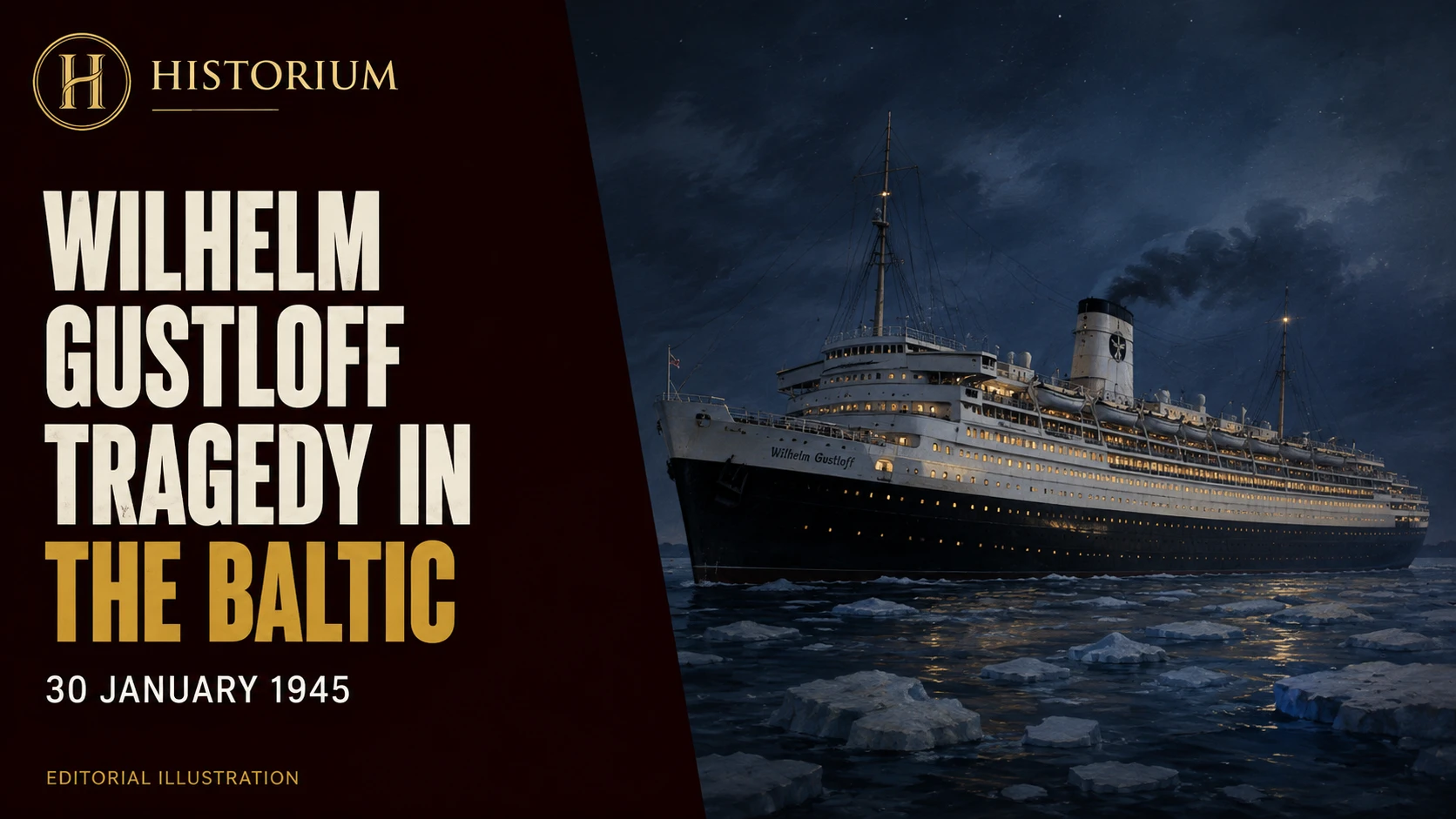
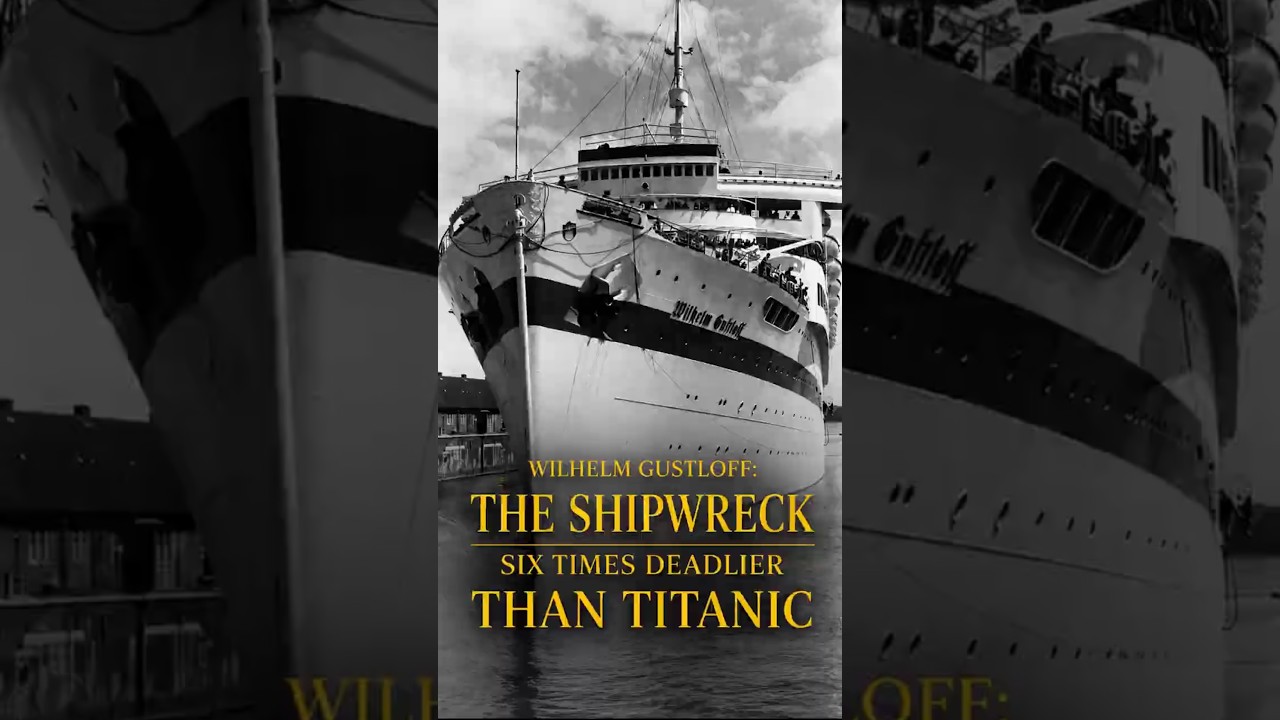
On the evening of 30 January 1945, the German ship Wilhelm Gustloff sank in the Baltic after three torpedoes struck it. The attacker was the Soviet submarine S-13, commanded by Alexander Marinesko. Thousands of people died during an evacuation that had promised a passage away from the approaching front. Museums describe the loss as the deadliest single-ship maritime disaster, while also acknowledging that the number aboard cannot be established precisely.
That uncertainty should shape the telling. The date, the ship and the scale of the catastrophe are well established. A casualty figure carried to the last digit, or an exact multiplier comparing it with another sinking, suggests a certainty the surviving evidence does not support.
From Propaganda Ship to Wartime Transport
The vessel’s name carried a political message before it carried refugees. Wilhelm Gustloff was the leader of the Nazi Party’s organization in Switzerland. After David Frankfurter shot him in Davos in February 1936, the regime turned his death into a propaganda occasion. The German Federal Archives’ documents and account describe that campaign and the naming of a German Labour Front passenger ship after him.
The ship subsequently served the Nazi leisure organization Kraft durch Freude, or Strength Through Joy. Its comfortable passenger spaces belonged to a project promoting the regime’s social image. Wartime service changed its function: it was used as a hospital ship and later to accommodate U-boat personnel. The Historisches Marinearchiv’s vessel record identifies its naval accommodation role and connects the final voyage to reports by naval personnel.
These successive uses are easy to collapse in a short caption. A photograph showing an earlier hospital configuration does not establish what the vessel was doing on its last voyage. The relevant question is its role, passengers and military use at the time of the attack.
The Coast Became an Escape Route
By January 1945, the Soviet advance had made a maritime evacuation urgently important. Operation Hannibal moved German military personnel and civilian refugees westward from Baltic ports. Historian Robert Citino’s account for the National WWII Museum describes winter journeys toward the coast, confused authority and disputes over priorities as refugees arrived.
Wilhelm Gustloff sailed from Gotenhafen, the German occupation name for Gdynia, on 30 January. Its passengers included civilians and naval personnel. The marine archive lists several categories separately, including female naval auxiliaries. This was neither an ordinary peacetime passenger crossing nor a ship carrying only one easily counted group.
For families, boarding could seem like the end of the most immediate danger. Yet a berth on an overcrowded evacuation ship transferred them into another wartime environment. Sea routes remained vulnerable to submarines, and moving large numbers of people did not make the vessels carrying them immune from attack.
Three Hits in a Winter Sea
The attack came during the evening passage west. After the torpedo impacts, people had to move through a crowded, damaged ship that was losing stability. Darkness, ice and limited access to boats turned escape into a problem that extended far beyond reaching the deck.
NDR’s reconstruction and survivor reporting describes electrical failure, heavily iced boats and passengers struggling as the ship listed. It also records the rescue work of the torpedo boat T-36. The people pulled from the sea had survived a chain of dangers: the explosions, movement through the ship, abandonment and immersion in cold water.
The German Maritime Museum’s presentation of survivor-based documentary work gives approximately 1,200 survivors from roughly 10,000 people aboard. These rounded figures communicate the imbalance between those saved and those lost. They should not be turned into an exact subtraction masquerading as a recovered passenger list.
Why the Death Toll Remains an Estimate
The Museum of the Second World War in Gdańsk explicitly says the precise number killed is unknown and gives an estimated range of 7,000–10,000. Other institutional accounts use different ranges or round the toll to around 9,000. The variation reflects uncertainty in the starting population as well as the reconstruction of who survived.
The marine archive makes the problem visible by retaining entries based on different sources with substantially different passenger totals. Its page points to naval reports and later research. Such a compilation should be read as evidence of the reconstruction process, not treated as though every number on it describes the same complete register.
Consequently, “around 9,000 dead” is a broad estimate, not a verified roll of names. Nor does repeating a number across many websites make those websites independent confirmations. An honest account can describe a disaster of exceptional scale while leaving the uncertain digits uncertain.
Civilians Aboard a Military Evacuation
The presence of civilian refugees does not erase the vessel’s military function. Citino notes naval personnel and antiaircraft armament in explaining why historians have regarded it as a military target. Equally, identifying a military function does not make every person aboard a combatant or diminish the suffering of children and other civilians.
Those distinctions allow the event to be examined without treating legal classification as a verdict on whose grief counts. The people on the lower decks were not abstractions in a naval calculation. Their deaths belong in the history of the war alongside the decisions and circumstances that placed them there.
A Bell, and the Work of Remembering
In Gdańsk, a surviving object offers a different scale of attention. The museum holds a signal bell recovered from the wreck by Polish divers in 1979. Produced in Bochum in 1937, it had been positioned at the stern. Its documented identity connects the vessel’s material history to the seabed where the catastrophe ended.
The disaster also became a subject of literature and argument. In an essay excerpt published by Germany’s Federal Agency for Civic Education, historian Ute Frevert examines renewed attention to German suffering, including Günter Grass’s Im Krebsgang. She challenges the idea that such experiences had simply vanished from all earlier public memory.
Remembering the refugees need not sever their story from the Nazi war that produced the catastrophe’s setting. Nor should that setting remove individuals from view. The strongest account holds both together: the ship’s political and military history, the collapsing evacuation, the rescuers and the many people whose final passage ended in the Baltic.