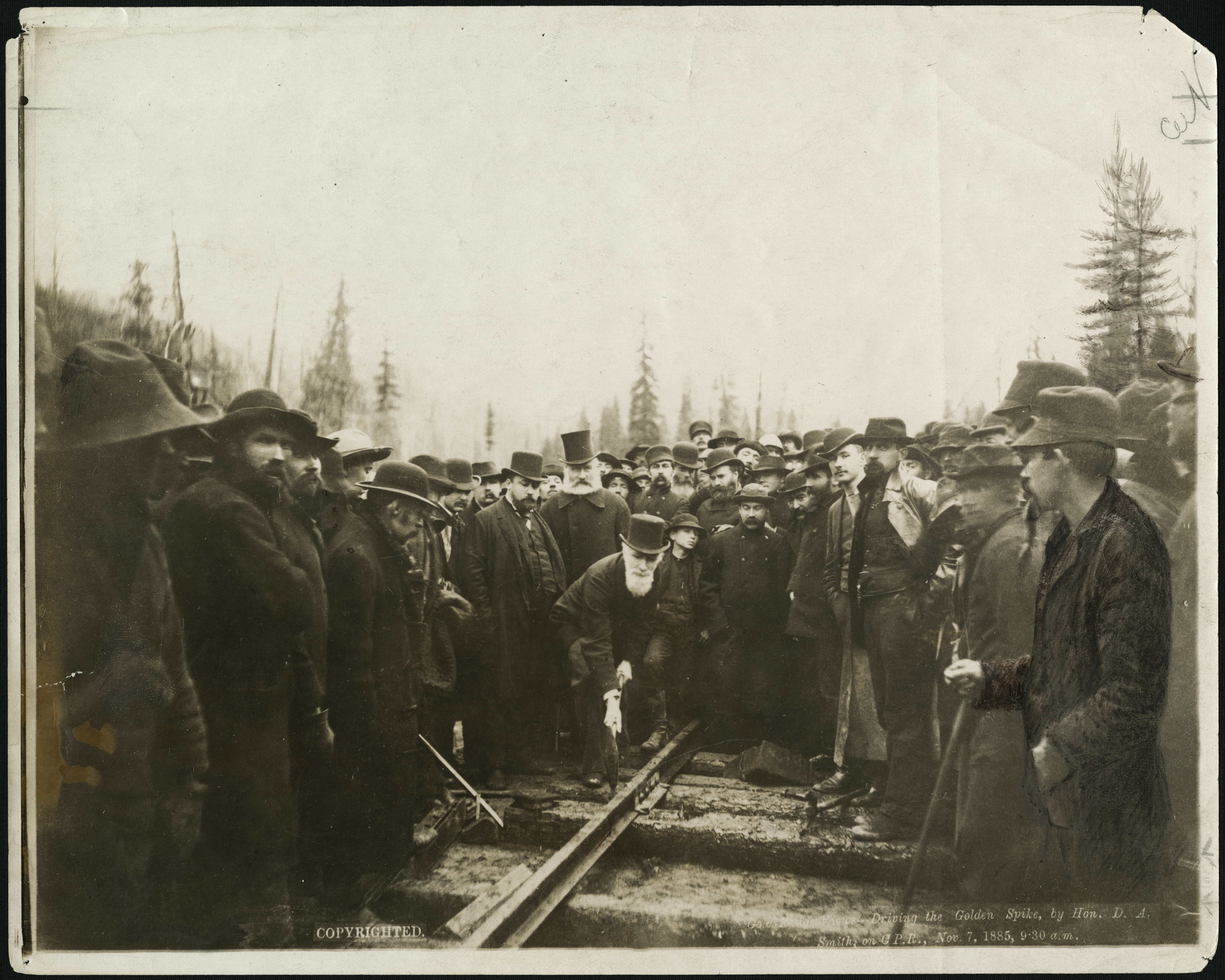
The ceremony took place at Craigellachie, British Columbia, on November 7, 1885. Smith, a company director, drove the spike where the railway’s eastern and western construction efforts met. The line was joined. The photograph, though, could not show all the people, money, political bargains and dangerous work that had made that small patch of track possible.
A promise older than the company
British Columbia entered Confederation in 1871 with a promise of a railway connection to eastern Canada. Delivering it was a different matter. The project became entangled in political scandal, delays and financial trouble. The Canadian Pacific Railway Company was incorporated in 1881; William Cornelius Van Horne became its general manager the following year.
Van Horne pushed construction across the Prairies and into the mountains. Engineering difficulty varied enormously along the route. Photographs of bridges north of Lake Superior show another part of the job often overshadowed by mountain scenery: a continuous railway required river crossings, cuttings and solid roadbeds across the entire distance. A missing bridge anywhere could interrupt the whole route.
Nor did the CPR alone build every mile of a coast-to-coast network. Its route connected Port Moody on the Pacific with Montréal. Other railways carried the connection onward to Halifax. The national achievement depended on joining existing systems as well as laying new track.
The people outside the famous frame
Chinese workers were essential to construction in British Columbia. Parks Canada’s commemorative account estimates that they made up about three-quarters of the workforce on the section between the Pacific and Craigellachie. They received lower wages than white workers and faced dangerous blasting, unstable slopes, poor food and inadequate medical care. Hundreds died. Exact totals vary among historical accounts and should not be treated as a settled ledger.
Their absence from the last-spike photograph matters. A separate image of Chinese men working on the line in 1884 gives the ceremony its missing context: track construction meant sustained physical labor, much of it done by people who received little public recognition. A photograph from Glacier Park in 1889 also puts limits on the word “finished.” Crews still had a railway to maintain.
In the same year as the ceremony, Canada imposed a $50 head tax on Chinese immigrants. The state that had relied on their labor made entry more expensive for their countrymen and families. For Indigenous peoples, meanwhile, the railway’s expansion accompanied the seizure of land and forced displacement. A connection celebrated by officials could also carry settlers into territories whose existing inhabitants had not consented to losing them.
Joined track was not a passenger timetable
Regular transcontinental passenger service began the following year. The first regular train left Montréal on June 28, 1886, reaching Port Moody on July 4. That distinction keeps November 7 in focus: it marked the completion of the track connection, not the departure of the first scheduled coast-to-coast passenger journey.
Van Horne sent the news to Prime Minister John A. Macdonald by telegram. That surviving sheet and Ross’s photograph record two versions of the same day: the message officials wanted to transmit and the group assembled to embody it. The construction photographs add something less ceremonial. They show how much bridgework, earthmoving and human effort had to disappear into an apparently simple line on a map.
Cover image: Alexander Ross / Library and Archives Canada, C-003693. Historical photograph in the public domain; archive scan also offered under CC BY 2.0, unchanged