The telegram catches something later commemorations tend to remove: uncertainty. Kerensky still hoped to reverse the situation. The ambassador could not know how many soldiers would answer him. A seizure of power was unfolding, rather than arriving as a finished scene from a history book.
Why November is called October
The date needs explaining first. Russia still used the Julian calendar in 1917. November 7 on the Gregorian calendar was October 25 in Russia. The name “October Revolution” preserves that older reckoning. Events continued through the night, and the arrest of the ministers in the Winter Palace belongs to the early hours of October 26, or November 8.
This was the second revolution of the year. The first, in February by the Russian calendar and March by the Gregorian, had brought down Nicholas II’s monarchy. A Provisional Government followed. Its authority remained insecure as war, shortages and competing political demands wore away public confidence.
Workers, soldiers and sailors had already taken to the streets during the July Days. Photographs of that earlier violence are sometimes folded into a general picture of “the revolution.” Their dates matter. A bullet-damaged shop window from July records one stage of the crisis, several months before the Bolshevik takeover.
Power moves before the palace falls
By November, armed forces supporting the Bolsheviks were taking key positions and government buildings in Petrograd. The movement was led politically by Vladimir Lenin and organized through revolutionary institutions, including the Military Revolutionary Committee. Kerensky’s cabinet lacked reliable defenders. Occupying communications and centers of authority mattered more than any single dramatic charge.
The Winter Palace was nevertheless a potent target. The former imperial residence had become a military hospital as well as a seat of the Provisional Government. Kerensky and his staff had moved there during the summer. Taking it meant capturing the ministers and occupying a building still associated with state power.
The Hermitage’s account describes a diminished defense by the time Vladimir Antonov-Ovseyenko and his companions entered. Many defenders had already departed. The remaining ministers, gathered in the Small Dining-Room, ordered resistance to stop rather than prolong the bloodshed. They were arrested during the night of November 7–8.
The image that came afterward
Large crowds charging across Palace Square became the enduring picture of October. Yet familiar photographs of a mass assault can come from a different event entirely: a theatrical reenactment staged in 1920. Director Nikolai Evreinov organized an enormous spectacle for the revolution’s third anniversary, and cameras recorded the performance.
Those pictures are historical evidence of how Soviet power wanted to remember its beginning. They are not eyewitness photographs of the seizure in 1917. A date in a caption can change the purpose of an image completely.
Nor did control of Petrograd settle Russia’s future overnight. Civil war followed, involving Bolshevik forces, their varied opponents, nationalist movements and foreign intervention. The Bolshevik government withdrew Russia from the First World War through the Treaty of Brest-Litovsk in March 1918, surrendering extensive territory in the process.
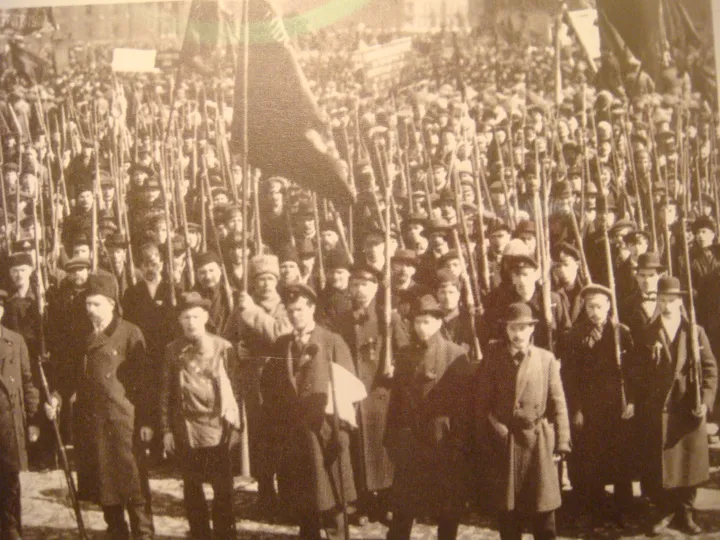
November 7 therefore marks a turning point, not a tidy conclusion. The monarchy had already fallen; a durable new state had yet to be secured. Contemporary photographs and diplomatic messages restore the distance between those facts. They show people organizing, guarding streets and trying to understand who now had the power to give orders.
Cover image: Unknown photographer / Historical photograph reproduced in a 1920s book; scan via Wikimedia Commons. Public domain; Commons Public Domain Mark