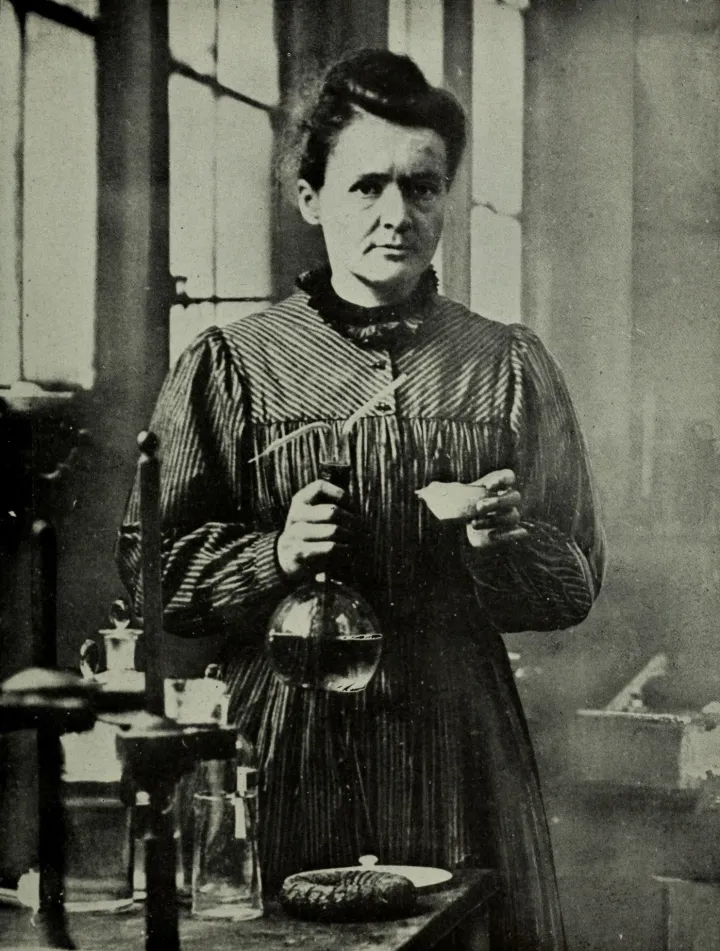
Her story began in Warsaw on November 7, 1867. Born Maria Skłodowska in a city under Russian rule, she grew up in a family of teachers. The familiar surname came later, after her move to Paris in 1891 and marriage to the physicist Pierre Curie in 1895. The distance between those two cities was only part of the journey. Access to advanced education, money and laboratory space all had to be negotiated.
The mineral that refused to add up
Henri Becquerel’s discovery of radiation from uranium in 1896 offered her a research problem. Curie compared the activity of different materials using electrical measurements. Some uranium minerals were more active than their uranium content could explain. That discrepancy mattered more than any picturesque glow in a darkened room. It suggested that something else was present.
Pierre joined the investigation. In 1898 the Curies announced polonium, named for Marie’s homeland, and then radium, the latter discovery made with Gustave Bémont. Announcing an element and obtaining a pure sample were different achievements. Separating tiny quantities from large amounts of mineral residue demanded repeated chemical processing, careful measurement and years of work.
The photographs can make the laboratory look almost domestic: bottles on shelves, a table, two people sitting close to their equipment. The work was anything but casual. Their instruments made faint effects measurable. Their chemical separations allowed them to follow those effects into increasingly concentrated fractions.
Two prizes, different work
In 1903 the Nobel Prize in Physics went jointly to Becquerel and the Curies for research into radiation. Marie became the first woman to receive a Nobel Prize. Eight years later she received the chemistry prize for her work on radium and polonium, including the isolation of radium and study of its compounds. She was the first person awarded two Nobels.
Between those ceremonies came a devastating interruption. Pierre died in a Paris traffic accident in 1906. Marie took over his teaching position, becoming the first woman professor at the Sorbonne. Raising Irène and Ève, teaching and sustaining a research program were simultaneous obligations, not separate chapters conveniently closed before the next began.
During World War I she helped organize mobile radiological equipment and train operators. X-rays were already an established discovery; Curie’s contribution was to make equipment and expertise more available to military medicine. A surviving photograph of her 1916 training course shows that this work involved teaching other people how to use the machinery, as well as bringing it closer to casualties.
Fame could not equip a laboratory
The American visit exposed the practical limits of celebrity. Journalist Marie Mattingly Meloney organized a campaign that raised $100,000 to buy a gram of radium for research. American women supplied the funds. The National Bureau of Standards measured the material, divided it into sealed tubes and arranged its shipment to France.
That is what makes the White House photographs so revealing. There is the celebrated scientist, surrounded by the machinery of a public honor. Away from the reception, another kind of machinery was doing the essential job: instruments checking the strength of a source, technicians preparing its packaging, a laboratory waiting for it to arrive. Curie’s birthday commemorates a life in science. The gram of radium shows what keeping that science going actually required.
Cover image: Unknown photographer / Wikimedia Commons. Public domain; anonymous historical photograph