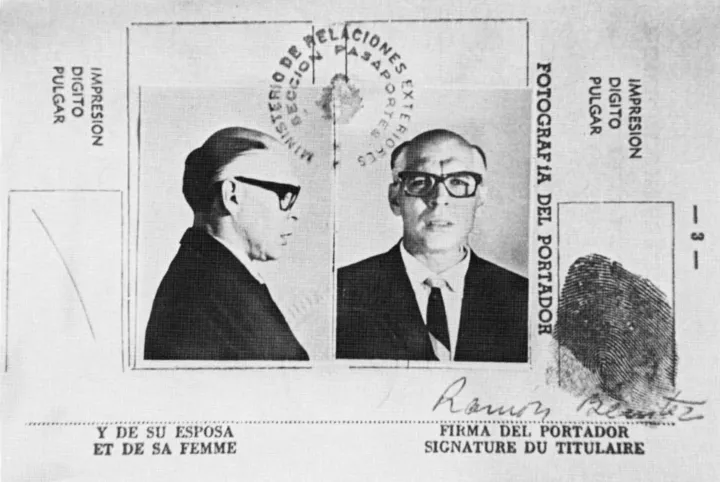
The signature in the false passport reads Ramón Benítez. The man in its photograph is Che Guevara, prepared for travel under another identity. The missing beard and altered hairline are the most immediately visible changes.
Another name, Adolfo Mena González, became associated with his clandestine arrival in Bolivia in November 1966. That cover presented him as a Uruguayan researcher linked to the Organization of American States. Behind these identities was a plan to establish a guerrilla force and extend armed revolution across South America. [1]
The photograph preserves the finished appearance. The work that produced it is harder to reconstruct. It involved a dentist, false documents, months of preparation and a surprisingly practical concern: how quickly his hair would grow back.
A year spent moving under cover
The transformation developed during the interval between Guevara’s failed Congo expedition and his Bolivian campaign. He withdrew to Tanzania in late 1965, spent roughly March to July 1966 in Czechoslovakia, and then returned secretly to Cuba to prepare for South America.
Prague offered an established network of accommodation, travel assistance and false documentation used by Cuban intelligence. Historian Michal Zourek’s study places Guevara’s stay within that wider cooperation between the Cuban and Czechoslovak services. The arrangements were compartmentalized: providing assistance did not necessarily mean knowing the traveler’s true identity.
Different names belonged to different stages of the journey. Guevara left Czechoslovakia carrying a Uruguayan passport in the name Ramón Benítez. Adolfo Mena González belonged to the later Bolivian operation. The surviving accounts therefore need to be read as a sequence, with adjustments made along the way. [2]
The dentist and the disappearing hair
Luis Carlos García Gutiérrez, known as Fisín, was a Cuban dentist experienced in disguise work. Reporting on his memoir describes the equipment prepared in Tanzania: dental prosthetics, a padded garment that altered Guevara’s silhouette, shoes that increased his apparent height and glasses. The upper and lower dental pieces changed the proportions of his lower face, increasing the distance between the base of his nose and his chin. These details belong to an earlier stage of the disguise, before the final departure for Bolivia. [3]
Fisín later recalled a further change at the training camp in Pinar del Río, Cuba. In an interview published in Alicia Elizundia’s Bajo la piel del Che, he said the physician Octavio de la Concepción de la Pedraja, nicknamed Moro, anesthetized Guevara’s scalp with lidocaine and pulled out his hair.
According to Fisín, the procedure was repeated twice so Guevara could establish how long regrowth took. He wanted the bald appearance to last through the journey. Fisín also said the dental overlay made for the departure from Africa would be used again for South America. [4]
The purpose of Adolfo Mena González
The OAS researcher identity gave the traveler a civilian explanation for being abroad. It also distanced him from the military figure whose public appearances had made his face recognizable.
Guevara intended Bolivia to become a base for a broader revolutionary effort. His strategy rested on the belief that a small rural guerrilla force could expand, attract local support and encourage movements in neighboring countries. Cuban veterans would help train and lead the new organization. The first camp and its supply arrangements were being prepared before he joined it. [1]
The disguise served the journey into that operation. Once he reached the countryside, another set of problems would determine whether the campaign could survive.
His own face began to return
Guevara’s Bolivian diary supplies a contemporary record of the disguise wearing off. On November 12, 1966, he noted that his hair was growing back sparsely, the gray was becoming blond and disappearing, and his beard was returning.
He expected to look like himself again within a couple of months. The observation occupies only a few lines among camp preparations and arrangements for incoming men. Its casual placement is revealing: the altered face had been a temporary requirement, and he was already watching it disappear. [5]
For the reader, that entry provides something the passport portrait cannot: a dated account of the transition back from the traveler’s appearance to the guerrilla commander’s.
Two passports and the same fingerprints
By May 1967, the CIA was collecting accounts from captured people who said they had encountered Guevara in Bolivia. A field report dated May 10 placed him with the guerrillas during the preceding weeks, drawing partly on interrogations that included the French intellectual Régis Debray. [6]
Physical documents provided another line of inquiry. In a September 6 memorandum to President Lyndon Johnson, Walt Rostow summarized the examination of material recovered by Bolivian security forces. Two passports carried different names but the same photograph and fingerprints. The prints matched earlier records of Guevara held by the CIA.
The analysis also suggested travel from Madrid to São Paulo in late October 1966 and onward to La Paz on November 3. Rostow preserved the distinction between strong evidence and certainty: the findings supported Guevara’s arrival the previous November, but the assessment still stopped short of conclusive proof. [7]
The photograph that remained
The campaign struggled to build the political and local support Guevara had expected. His dispute with Bolivian Communist Party leader Mario Monje weakened connections between the rural force and the cities. Recruitment remained poor. By late 1967, the guerrillas faced an increasingly effective pursuit, including a Bolivian Ranger battalion trained with U.S. assistance. The difficulties of sustaining the force had overtaken the earlier problem of entering the country unnoticed.
Guevara was captured in October 1967 and executed on October 9 by Bolivian troops. A CIA operative, Félix Rodríguez, was present. Declassified records show the continuing interest of senior U.S. officials in locating him, confirming his death and assessing its consequences for revolutionary movements. [8]
The dental work also left a record. According to the forensic account reported by La Jornada, casts preserved from the disguise were among the materials used decades later to identify the remains recovered in Bolivia. [3]
The passport portrait survives as a record of the earlier, quieter part of that story. Together with the diary, Fisín’s recollections and the intelligence documents, it lets us follow the disguise from its preparation to the evidence examined after his identity had come under investigation.
Cover image: a false Uruguayan passport bearing the signature Ramón Benítez, reproduced by U.S. Army Special Operations history and held on Wikimedia Commons under its PD-Cuba designation. The image’s published caption associates it with Adolfo Mena González; the visible signature identifies a different alias.