

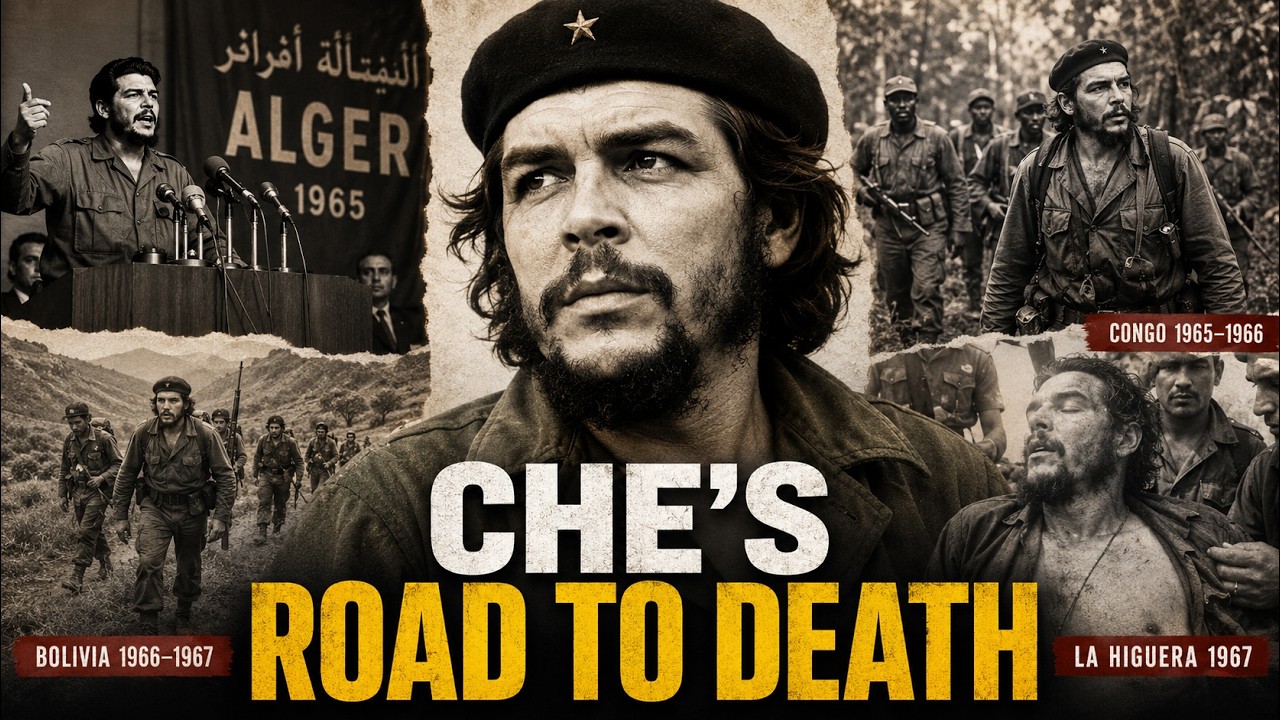
From his explosive 1965 speech in Algeria to the failed Congo campaign, the mountains of Bolivia, and a small schoolhouse in La Higuera, this is the story of the choices that carried Che Guevara toward his final confrontation.
In February 1965, Ernesto “Che” Guevara stood before representatives of newly independent nations and liberation movements in Algiers and delivered one of the most confrontational speeches of his political life.
He was already internationally known as a commander of the Cuban Revolution, Cuba’s minister of industries, and one of the most recognizable figures in the global struggle against Western imperialism. Yet on that day, Guevara did more than condemn the United States and Europe.
He openly challenged the economic behavior of the socialist countries upon which Cuba increasingly depended.
The speech did not immediately sentence him to death, nor did it single-handedly force him out of Cuba. His journey into international guerrilla warfare was already taking shape. But Algiers became a symbolic turning point: the moment when Guevara publicly declared that revolutionary principles mattered more to him than diplomacy, government office, or personal security.
Within weeks, he would disappear from public life.
Within months, he would be fighting in the Congo.
Less than three years later, he would be lying wounded and disarmed in a Bolivian ravine, surrounded by soldiers.
The Speech That Changed the Direction of His Life
On February 24, 1965, Guevara addressed the Second Economic Seminar of Afro-Asian Solidarity in Algiers. The gathering included representatives from 63 African and Asian governments and 19 national liberation movements. Algeria, only recently freed from French colonial rule, provided an especially powerful setting for his message.
Guevara argued that political independence meant little without economic liberation. Former colonies could remove foreign flags and still remain controlled through debt, trade inequality, foreign investment, and dependence on industrialized powers.
His most controversial accusation, however, was directed at the socialist bloc.
Guevara declared that socialist countries had a moral responsibility to end their “tacit complicity” with Western exploitation. He argued that when socialist states traded with poor nations according to conventional market rules, demanded repayment, or benefited from unequal prices, they risked behaving like the capitalist powers they claimed to oppose.
This was an extraordinary position for a senior Cuban official.
Cuba’s economy had become deeply connected to the Soviet bloc. The Soviet Union purchased Cuban sugar, supplied oil and industrial equipment, and provided military and financial assistance at a time when the United States was attempting to isolate the island.
Guevara acknowledged that Cuba itself benefited from favorable Soviet trade agreements. But he insisted that solidarity could not be limited to countries of strategic importance. In his view, socialist nations had to assist liberation movements and developing countries even when doing so offered no immediate economic return.
His criticism reflected a deeper ideological disagreement.
Guevara believed revolution demanded sacrifice, internationalism, and the creation of a fundamentally different moral and economic system. He feared that the Soviet Union was becoming too cautious, bureaucratic, and willing to coexist with the capitalist world.
For Moscow, such statements from a prominent Cuban minister were deeply uncomfortable. For the Cuban leadership, which needed Soviet support while attempting to maintain some revolutionary independence, they created a serious diplomatic problem.
Did the Algiers Speech Force Che Out of Cuba?
The popular version of the story presents a simple chain of events: Guevara denounced the Soviet Union, returned to Havana, confronted Fidel Castro, and was forced to disappear.
The historical evidence is more complicated.
Cuba had already decided to support revolutionary forces in the Congo before Guevara returned from Africa. A covert Cuban expeditionary force was being prepared, and Guevara’s decision to lead it appears to have been made with Castro’s knowledge and support. His departure was therefore not merely an exile imposed as punishment for the Algiers speech.
Nevertheless, the speech revealed how far Guevara’s priorities had moved away from the responsibilities of government.
He returned to Havana on March 14, 1965, where Fidel Castro and other senior officials greeted him at the airport. It would be his last public appearance in Cuba. Soon afterward, he vanished from view.
Before leaving, Guevara wrote a farewell letter to Castro dated April 1, 1965. In it, he declared that he was resigning from the Communist Party leadership, his ministerial position, his military rank, and his Cuban citizenship.
“Other nations of the world” now required his efforts, he wrote. He also attempted to free the Cuban government from responsibility for whatever he might do abroad.
The letter was not made public immediately. Castro read it to the Cuban people in October 1965, while Guevara was secretly fighting in Africa.
To the outside world, Che Guevara had simply disappeared.
Why Che Chose the Congo
The Congo Crisis had become one of the most violent Cold War struggles in Africa.
The country had gained independence from Belgium in 1960, but its first years of freedom were marked by mutiny, secession, foreign intervention, and the assassination of Prime Minister Patrice Lumumba. To Guevara, Lumumba’s death represented the brutality of neocolonialism: formal independence undermined by foreign governments, corporations, mercenaries, and local allies.
By 1964, the Simba Rebellion had spread across large areas of the country. The rebels drew support from Lumumba’s political legacy and opposed the Western-supported government associated with Moïse Tshombe.
Belgian paratroopers, transported with American assistance, intervened at Stanleyville in November 1964. The operation helped government forces retake the city and intensified demands among radical African governments for outside assistance to the Congolese rebels.
Guevara believed the Congo could become a center of international revolution. From the heart of Africa, trained guerrillas might support movements in neighboring territories and confront Western influence across the continent.
He arrived in Tanzania in April 1965 under heavy disguise. With a small initial group of experienced Cuban fighters, he crossed Lake Tanganyika and entered eastern Congo. More Cuban personnel later joined the expedition, bringing the contingent to well over one hundred men.
The Cubans intended to train and support fighters connected to the Simba movement, including forces associated with Laurent-Désiré Kabila.
Guevara expected commitment, discipline, and a shared revolutionary purpose.
What he encountered was fragmentation.
“This Is the History of a Failure”
The Congo campaign exposed the limits of Guevara’s belief that the Cuban revolutionary model could be transferred to another country.
The Congolese opposition was divided among leaders, regions, and political factions. Some senior figures spent long periods outside the combat zone. Guevara complained about weak organization, unreliable information, poor discipline, and commanders who appeared more comfortable in exile than among their fighters.
Communication was another major obstacle. Many Cubans spoke neither French nor Swahili, while cultural differences complicated relations with the local forces.
Guevara also struggled to understand the political rivalries surrounding him. Unlike in Cuba, where he had fought inside a movement with strong leadership and a growing support network, he was now an outsider attempting to impose order on a conflict with its own history and internal tensions.
His health deteriorated as well. Guevara had suffered from severe asthma throughout his life, and in the Congo he experienced both asthma attacks and malaria. The humid environment, limited medical resources, physical exhaustion, and constant uncertainty made command even more difficult.
The military situation continued to worsen. Government troops and foreign mercenaries increased pressure on the rebel-held areas, while the revolutionary coalition gradually disintegrated.
By November 1965, the Cuban position had become untenable. The expedition withdrew across Lake Tanganyika.
Guevara later opened his account of the campaign with a devastating judgment:
“This is the history of a failure.”
He did not write those words merely as an expression of defeat. He wanted the experience studied so that future revolutionary movements might understand what had gone wrong.
The Congo had taught him that courage and ideology could not compensate for weak political organization, divided leadership, limited local support, and an inadequate understanding of the society in which a guerrilla force operated.
Yet he did not abandon his central belief.
Instead of concluding that international revolution was impossible, he searched for another battlefield.
From Africa to the Heart of South America
After leaving the Congo, Guevara could not immediately return to public life in Cuba.
His farewell letter had already been read to the Cuban population. He had publicly renounced his positions and declared that he was leaving to fight elsewhere. A visible return following the African defeat would have been politically difficult and personally humiliating.
He remained hidden while planning another campaign.
Bolivia offered several strategic advantages. Located near the center of South America, it bordered Argentina, Brazil, Chile, Paraguay, and Peru. Guevara believed that a successful insurgency there could spread across national boundaries and eventually create a continental revolutionary movement.
In late 1966, he secretly entered Bolivia in disguise and traveled to a remote base near the Ñancahuazú River.
His diary entry for November 7 began with a simple declaration:
“Today a new stage begins.”
But many of the problems that had destroyed the Congo campaign were about to return in an even more dangerous form.
The Bolivian Campaign Begins to Collapse
Guevara’s group included Cubans, Bolivians, and several foreign revolutionaries. Initially, the guerrillas were reasonably equipped and achieved some limited military successes against inexperienced Bolivian troops.
The political foundations of the campaign, however, were weak from the beginning.
Guevara clashed with Mario Monje, the leader of the Communist Party of Bolivia, over who would control the movement. Monje was unwilling to place the party fully under Guevara’s military command. Their disagreement deprived the guerrillas of the political organization, recruits, urban contacts, and logistical support that Guevara had expected.
The local peasantry also failed to respond as he hoped.
Many rural families regarded the armed outsiders with suspicion. The guerrillas did not have deep roots in the region, and some local people feared that their presence would bring military retaliation. Information about the rebels’ movements began reaching the authorities.
Che himself later acknowledged his disappointment at the absence of popular support. In a conversation after his capture, he reportedly said the government had successfully portrayed the campaign as a foreign invasion.
The guerrilla force became increasingly isolated.
Radio contacts failed. Supply networks collapsed. One section of the group became separated from the main force. Food, medicine, clothing, and ammunition grew scarce. Guevara’s asthma worsened as he moved through the rugged terrain without reliable access to medication.
Meanwhile, the Bolivian military was improving.
American advisers trained a special ranger battalion for counterinsurgency operations, while CIA personnel assisted the Bolivian authorities with intelligence and operational guidance. The Second Ranger Battalion would eventually play the central role in Guevara’s capture.
By the final months of the campaign, the revolutionary army that Guevara had hoped would expand across the continent had been reduced to a small, exhausted group struggling to survive.
The Manhunt Reaches the Yuro Ravine
On October 7, 1967, Guevara made the final entry in his Bolivian diary.
The next day, Bolivian troops surrounded his group in the Quebrada del Yuro, commonly called the Yuro Ravine, near the village of La Higuera.
A firefight began on October 8.
Guevara was wounded in the leg, and his weapon was rendered unusable. Several of his fighters were killed, captured, or scattered. With no effective means of resistance, he was taken alive by soldiers from the Bolivian Second Ranger Battalion.
Declassified American records later confirmed that he had suffered a leg wound but was otherwise in relatively stable condition after his capture. This directly contradicted the Bolivian government’s initial public claim that he later died from injuries sustained in combat.
Accounts differ over precisely what Guevara said when he surrendered. The widely repeated statement that he identified himself and declared that he was worth more alive than dead comes from later testimony and cannot be verified with complete certainty.
What is certain is that he was captured alive.
The soldiers tied him and carried him to La Higuera, where he was confined inside a small, dark schoolroom with a dirt floor.
The revolutionary who had once served as a minister, commanded armies, addressed the United Nations, and become a symbol across the world was now a prisoner in a remote Bolivian village.
The Decision to Kill Che Guevara
Guevara was questioned on the morning of October 9 but refused to provide operational intelligence.
According to a memorandum later sent by CIA Director Richard Helms, Guevara remained composed and spoke about Cuba, Fidel Castro, the failed Congo expedition, and the future of revolution in Latin America. He admitted that the Bolivian movement had suffered a devastating setback but continued to insist that his ideals would eventually prevail.
The question of what to do with him was decided far from the schoolroom.
A public trial would have been politically explosive. Guevara could have transformed a courtroom into an international platform. His imprisonment might have inspired hostage-taking attempts, demonstrations, or campaigns demanding his release.
At 11:50 a.m., the Second Ranger Battalion received a direct order from Bolivian Army headquarters in La Paz: Guevara was to be killed.
The execution was carried out at approximately 1:15 p.m.
Sergeant Mario Terán entered the room with an automatic weapon. According to later accounts, Terán was visibly nervous when confronted with the wounded prisoner.
Guevara had spent years speaking about sacrifice, death, and the duty of the revolutionary. Now, with no army and no possibility of escape, he faced the consequences of those beliefs alone.
What Were Che Guevara’s Actual Final Words?
Che Guevara’s final words have been repeated in several different forms.
The best-known version is often rendered as:
“Shoot, coward. You are only going to kill a man.”
But the precise wording is disputed.
A declassified American memorandum written only days after the execution reported that Guevara told the man assigned to kill him:
“Remember, you are killing a man.”
The same document claims that he asked for a message to be delivered to his wife and predicted that revolution would rise again in the Americas.
Mario Terán later gave a somewhat different recollection. He said Guevara told him to calm down and aim carefully because he was about to kill a man.
The variations may reflect imperfect memory, translation, political mythmaking, or the gradual transformation of a private exchange into legend.
What remains consistent across the accounts is Guevara’s composure. He did not beg Terán for mercy. Instead, he confronted the soldier with the distinction between killing an individual and destroying the cause that individual represented.
Terán then fired.
Che Guevara was 39 years old.
The Death of a Man and the Birth of a Myth
After the execution, Guevara’s body was flown to Vallegrande and displayed publicly in the laundry room of a hospital.
The Bolivian authorities intended the display to prove that the famous revolutionary was truly dead. Journalists and local residents were permitted to see and photograph the body.
The result was the opposite of what his enemies intended.
Images of Guevara lying with his eyes partly open spread around the world. To many observers, the photographs appeared less like evidence of a defeated guerrilla and more like the representation of a martyr.
Bolivian officials initially maintained that he had died from wounds suffered in battle. Declassified records later established that he had been captured alive, held overnight, and deliberately executed on orders from the Bolivian military command.
His death transformed his public image.
For supporters, Guevara became a symbol of resistance, international solidarity, personal sacrifice, and refusal to compromise. His face appeared on posters, banners, walls, clothing, and protest movements far removed from the specific politics of the Cuban Revolution.
For critics, he remained an authoritarian revolutionary who supported political executions, armed struggle, and the creation of one-party socialist states.
Both interpretations are part of his legacy.
The human being was more complicated than either the heroic icon or the absolute villain. He was a physician who became a soldier, a government minister who rejected government life, an intellectual who believed violence could transform society, and a successful commander in Cuba who failed catastrophically when he attempted to reproduce that revolution abroad.
Did Che’s Road to Death Really Begin in Algiers?
Che Guevara’s death cannot be explained by one speech.
The Congo operation was already being developed with Cuban support, and his commitment to international revolution long predated the Algiers conference. He was not simply expelled from Cuba because he had angered Moscow.
But Algiers revealed the path he had chosen.
He publicly rejected the compromises required by diplomacy. He challenged not only his enemies but also the most powerful allies of the revolution he represented. Soon afterward, he surrendered his political offices, abandoned the protections of the Cuban state, and returned to clandestine warfare.
In the Congo, he discovered that revolutionary determination could not overcome fragmentation, cultural distance, and political disorder.
In Bolivia, he repeated many of the same mistakes under even harsher conditions. Without mass support, a reliable political organization, or a secure logistical network, his guerrilla force gradually became the target of an expanding military manhunt.
His journey ended on October 9, 1967, inside a village schoolhouse.
Yet the ideas, arguments, and contradictions surrounding Che Guevara did not end there.
In Algiers, he chose an uncompromising vision of revolution over the security of political office.
In the Congo, that vision suffered its first devastating defeat.
In Bolivia, Guevara followed it to its final consequence.
The bullets killed the man.
The story created the myth.