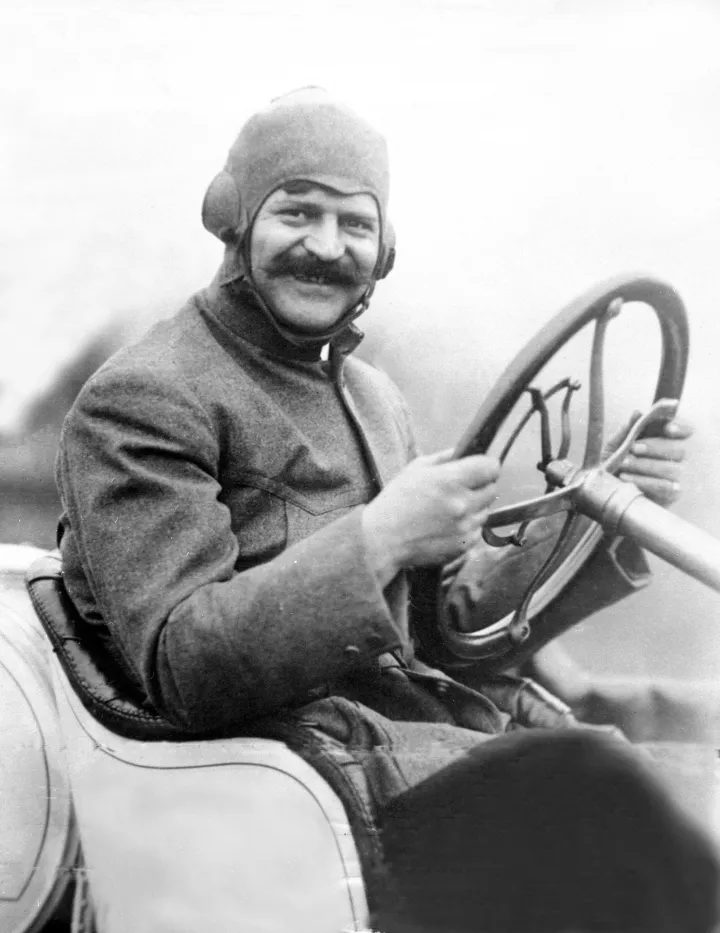
It was not the launch of a General Motors division. Durant had founded GM in 1908, then lost control of it in 1910 after rapid expansion and financial trouble. Chevrolet began outside that corporation. Its success would eventually help him return.
Two founders, different ambitions
Louis Chevrolet was born in Switzerland and made his reputation in American motor racing. Durant knew him through Buick’s racing operation. That connection offered practical knowledge, but also a recognizable name. A car carrying Chevrolet’s name could benefit from the attention earned on the track.
The early Chevrolet was a substantial six-cylinder automobile. The Series C, usually called the Classic Six, belonged to a more expensive part of the market than the inexpensive transport that Durant increasingly wanted to sell. Production followed the company’s formation; November 3 marks the business’s founding, not the first customer driving away in a finished car.
The distinction between the two men’s ambitions became difficult to sustain. Chevrolet favored powerful, costly automobiles. Durant saw a larger opportunity in selling to buyers considering Ford’s Model T. Louis left the company during its early years, while his surname remained on its cars. The brand’s history and the founder’s later life then followed different paths.
What an early Chevrolet offered
The Henry Ford preserves a 1915 Royal Mail roadster that makes the transition tangible. Its long hood, short rear section and tank behind the seats gave it a sporting appearance. Under the hood was a four-cylinder engine, and the listed price was $750. It was smaller and cheaper than the original six-cylinder Chevrolet, although hardly a casual purchase for an ordinary wage earner.
The next step was more direct. A Chevrolet sales brochure printed in 1915 advertised the Four Hundred and Ninety, introduced for the 1916 model year. The name referred to the touring car’s $490 starting price. In the museum’s comparison, Ford’s competing touring car started at $440.
Chevrolet’s argument was that the extra money bought something useful: somewhat more power and a conventional sliding-gear transmission rather than Ford’s planetary arrangement. A surviving brochure lets us see the competitive pitch at the time, before later brand loyalty made the rivalry seem inevitable.
The road back to General Motors
Durant used Chevrolet’s growth while accumulating General Motors shares. By 1916, Chevrolet held a controlling interest, and Durant returned to GM’s leadership. The sequence can sound backward to anyone familiar only with the later corporate structure: Chevrolet helped gain control of GM before becoming one of its divisions.
In May 1918, Chevrolet’s assets were brought into General Motors. That date belongs to the corporate consolidation, seven years after the company’s founding. It should not replace 1911 as the beginning of the Chevrolet story, nor should the later relationship be projected back onto the original partnership.
The first years were full of changes in price, engineering, ownership and purpose. A racing name became attached to an expanding range of passenger cars; a businessman used a new company to recover an older one. The early photographs and surviving vehicles show a business still deciding what kind of carmaker it would become.
Cover image: Photographer unidentified / Chevrolet historical photograph collection