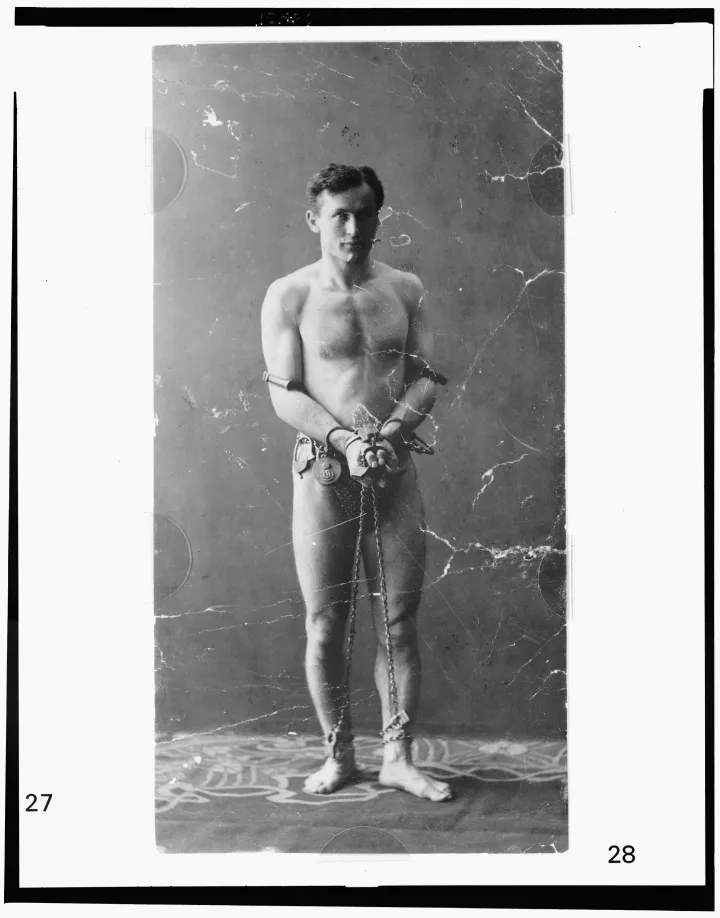
There was no final escape from a water tank. That belongs to the mythology surrounding him, not the medical circumstances of his death. His last days involved illness, travel and a determination to keep performing when his body was giving him reasons to stop.
The body behind the act
Witness accounts described a student striking Houdini in the abdomen in Montreal after asking about his ability to withstand blows. The episode became an explanation almost as famous as the performer. Yet a neat sequence of punch, burst appendix and death claims more certainty than the evidence permits. Appendicitis was the underlying illness; the blows' precise contribution remains disputed.
Houdini continued to Detroit and appeared at the Garrick Theatre on October 24, already seriously ill. Surgery followed, but the infection proved fatal. The difference between professional courage and a disastrous refusal to stop can be difficult to recognize while a performance is still in progress.
Making a name out of confinement
Born Erik Weisz in Budapest in 1874, he grew up in the United States and worked his way through small entertainment venues. The name Houdini paid tribute to the French conjurer Jean-Eugène Robert-Houdin. His marriage to Beatrice Rahner also became a working partnership. Bess was part of the enterprise that audiences eventually associated with one man's name.
A decisive change came in 1899, when impresario Martin Beck encouraged him to emphasize escapes. Handcuffs and jail cells supplied a clear proposition. The audience understood the obstacle before the act began, and could follow the suspense without understanding the technique. Houdini turned that simple structure into a career.
The scale kept growing. A giant water-filled milk can, introduced in 1908, made breath itself part of the spectacle. Bridge jumps carried the act into public space. His upside-down water-cell escape added a striking visual arrangement: the performer inverted, his ankles secured above the water, with an audience watching the confinement begin.
A showman who challenged other people's miracles
Houdini's attack on fraudulent spiritualists drew on the same professional knowledge. A stage audience bought a ticket to be deceived for pleasure. A bereaved customer approaching a supposed medium might believe that the dead were actually answering. Houdini argued that the distinction mattered.
He demonstrated techniques behind séance effects and published A Magician Among the Spirits in 1924. In 1926 he carried his campaign into congressional hearings on fortune-telling. Publicity and conviction were difficult to separate in his career, but neither cancels the other. He could seek a headline and still be appalled by a trick sold as supernatural comfort.
One surviving photograph places him beside an apparent Abraham Lincoln. It is a deliberate composite, created to demonstrate how easily a camera could manufacture the kind of apparition that spirit photographers advertised. The photograph's value lies in its confessed deception.
What he left behind
Houdini was also an unusually determined collector. In 1927 the Library of Congress received 3,988 volumes from his personal library, covering magic, spiritualism and related subjects. Books, correspondence, playbills and scrapbooks preserved the research behind the public persona.
Those records make a more interesting memorial than the idea that he possessed an impossible power. He studied, rehearsed, advertised and revised. The escape seemed extraordinary because the work that made it possible stayed largely out of sight. His death ended the performances. It did not end the audience's appetite for one more.
Cover image: Photographer unidentified / Library of Congress, via Wikimedia Commons; public domain.