
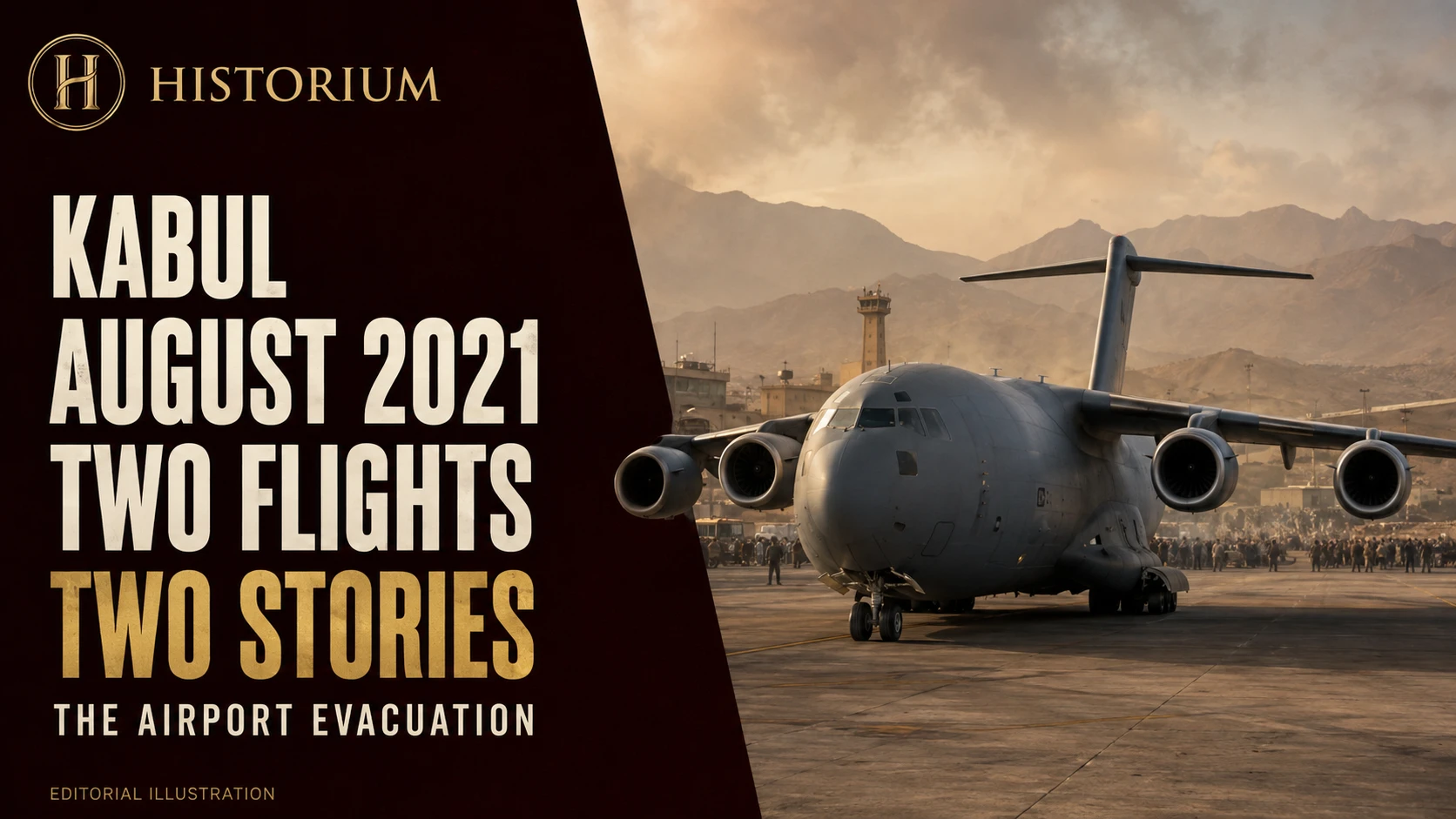

Images from Kabul airport in August 2021 can appear to tell one continuous story: people gathering around military aircraft, a crowded cargo compartment, and desperate attempts to escape. They instead document different moments during a rapidly changing emergency. Joining them without dates can merge a successful evacuation flight with a separate fatal incident.
A careful account begins with that distinction, then widens the frame. Aircraft and crews made individual journeys possible, but the circumstances drawing people toward the airport involved a collapsing government, a long war, disrupted communities and decisions taken far from the runway. Neither an airlift total nor a single traumatic image can explain the whole crisis.
The emergency before the runway
The Taliban entered Kabul on 15 August 2021 after a rapid series of advances. President Ashraf Ghani left the country that day, and the United States moved its embassy personnel to the airport. A Congressional Research Service report updated on 27 August records the sequence.
The humanitarian emergency was already extensive. On 13 August, UNHCR reported that approximately 400,000 Afghans had been forced from their homes since the beginning of the year. Its briefing described displacement preceding Kabul’s fall. These were people displaced within a wider conflict, not a count of airport passengers or of everyone who had left Afghanistan.
That distinction changes the scale of the story. People visible at the airport were only a fraction of those facing uncertainty. Others could not reach it, remained elsewhere in the country or had already moved from one Afghan community to another. The best-known departure point should not become a substitute for the experiences of an entire population.
REACH 871: 15 August and 823 passengers
Air Mobility Command’s correction, published on 20 August, states that a C-17 safely carried 823 Afghan citizens from Kabul on 15 August. An initial figure of 640 counted adults but omitted 183 children seated on laps. The official caption records the corrected passenger total. A separate Air Force account identifies the flight as REACH 871. That account explicitly connects the call sign with 823 evacuees.
The correction is more than a record-setting detail. Children count as people even when they do not occupy separate seats, and an early operational estimate can differ from a later passenger count. Retaining the corrected number while explaining the original figure avoids creating two imaginary flights from two reports about one journey.
The crowded cabin photograph records people who were aboard. It should not be presented as the interior of every aircraft seen outside on the runway. A matching aircraft type and location do not establish that two images concern the same flight.
REACH 885: the separate incident on 16 August
The next day’s fatal incident concerned a different flight, identified as REACH 885 in Coffee or Die’s reporting of the Air Force’s investigation statement. Human remains were discovered in the aircraft’s wheel well after it reached Qatar. In June 2022, the Air Force said its reviews found the crew had acted within the applicable rules and appropriately under the deteriorating security conditions. The report of 14 June 2022 identifies the flight and summarises the official statement.
That report also records limits: the spokesperson did not provide a death toll or identities, and did not confirm whether the aircraft was one of the C-17s in particular circulating videos. This article therefore does not assign every widely shared runway clip to REACH 885 or claim to have examined an unpublished investigation file.
An assessment of a crew’s conduct answers a narrower question than whether the evacuation was adequately prepared. It also does not remove the loss experienced by the families. Accuracy requires room for both the stated finding and the human consequences, without treating either as a shortcut around the other.
An airlift depended on more than pilots
A contemporary account by the commander of the 8th Expeditionary Aircraft Maintenance Squadron describes the pressure at Al Udeid in Qatar. Aircraft arrived rapidly while the existing maintenance workforce initially remained unchanged; the ramp and parking arrangements had to accommodate the surge. His September 2021 account documents work at a receiving and support base.
This expands the geography beyond Kabul. Every departure also needed somewhere to land, people to receive passengers and a serviceable aircraft for subsequent missions. A flight is a visible unit of achievement, but sustaining an evacuation requires a chain of activity across locations. Bottlenecks anywhere along that chain can affect what is possible at the departure airport.
What later reviews add
The State Department’s after-action review, summarised in the official April–June 2023 Lead Inspector General report, identified unclear senior responsibility, a complicated task-force structure and communication difficulties. It also described concern that evacuation preparations could undermine confidence in the Afghan government. The oversight report discusses those findings on pages 17–18.
SIGAR’s November 2022 assessment took a wider view of the government’s collapse. Its contributing factors included unpreparedness for the American withdrawal, exclusion from U.S.–Taliban negotiations, failed compromises, concentrated presidential decision-making and longstanding problems of legitimacy and corruption. Its evaluation distinguishes those interacting factors.
These reviews operate at different levels. A cockpit decision occurs within immediate conditions; an organisational review examines how those conditions developed; a political assessment considers why governing institutions failed. Combining them can illuminate responsibility more effectively than asking one document to settle every question.
Kabul’s airport should be remembered through that fuller record: people evacuated, lives lost, work performed under pressure and decisions requiring scrutiny. Separating REACH 871 from REACH 885 preserves the basic chronology. Looking beyond both flights preserves the people whose histories cannot be contained within the frame of a single photograph.