

At 5:19 p.m. on May 13, 1981, Pope John Paul II was moving slowly through St. Peter’s Square in an open vehicle, greeting the thousands of people who had gathered for his weekly general audience.
Then came the gunshots.
A 23-year-old Turkish gunman named Mehmet Ali Ağca had positioned himself among the crowd. He fired at the Pope at close range. John Paul II collapsed into the arms of his aides as the vehicle sped away across the square.
Within minutes, one of the most recognizable religious figures in the world was being rushed to Rome’s Gemelli Hospital with life-threatening injuries.
The Vatican records that John Paul II underwent approximately six hours of emergency surgery. He survived.
Ağca was captured at the scene.
What followed could easily have become a conventional story of an assassination attempt: the gunman, the investigation, the trial and the unanswered questions surrounding his motive.
Instead, four days later, the victim changed the direction of the story.
From his hospital bed, Pope John Paul II announced that he had forgiven the man who had just tried to kill him.
And two years later, he went to see him.
The Gunman in St. Peter’s Square
Mehmet Ali Ağca was not an unknown young man who suddenly decided to attack the Pope.
Two years earlier, on February 1, 1979, Turkish journalist and Milliyet editor Abdi İpekçi had been assassinated in Istanbul. Ağca was arrested in connection with the killing and imprisoned. He escaped from prison later that year.
What happened immediately afterward is particularly striking in retrospect.
According to a chronology contained in declassified U.S. government records, Ağca escaped on November 25, 1979. Two days later, he sent a letter to a Turkish newspaper threatening to kill John Paul II during the Pope’s approaching visit to Turkey.
The threat did not materialize during that visit.
Ağca remained at large. His movements over the following period took him through several European countries, including Bulgaria, before he eventually reached Rome.
Then, on May 13, 1981, the threat he had made more than a year earlier became very real.
Four Days After the Shooting
John Paul II was still recovering at Gemelli Hospital when, on May 17, his recorded voice was broadcast to the crowd gathered once again in St. Peter’s Square.
His message was remarkably brief.
After thanking people for their prayers and acknowledging others who had been wounded during the attack, he spoke about Ağca.
He asked his listeners to pray for the man who had shot him and stated that he had “sincerely forgiven” him.
Only four days had passed.
Ağca had not apologized to him publicly. The investigation had barely begun. The Pope did not yet know who, if anyone, had helped plan the attack.
His forgiveness therefore did not emerge at the end of a process of reconciliation. It came almost immediately.
That distinction matters.
John Paul II was not announcing that the crime should go unpunished. Ağca was prosecuted in Italy and sentenced to life imprisonment in July 1981. Nor did the Pope claim that the shooting should simply be forgotten.
For him, forgiveness and legal accountability were separate questions.
What Did Forgiveness Mean to John Paul II?
To understand the Pope’s response, it is necessary to look beyond the prison photographs that would later become famous.
John Paul II returned publicly to the subject several months after the attack.
During a general audience on October 21, 1981, he described forgiveness as “a grace and a mystery of the human heart.” He repeated the message he had delivered from the hospital and presented the decision to forgive within his understanding of Christian teaching.
This was not simply a public-relations gesture following an international crisis.
The idea that a Christian should forgive an enemy — even someone responsible for grave violence — lies at the center of the Gospel tradition that John Paul II preached throughout his papacy. Forgiveness, in this understanding, does not declare the act acceptable. It is a refusal to allow hatred and retaliation to become the victim’s answer to it.
That principle was easy to express from a pulpit.
In December 1983, John Paul II decided to put it into practice in a far more uncomfortable setting.
He asked to meet Mehmet Ali Ağca.
The Prison Cell
On December 27, 1983, the Pope arrived at Rebibbia Prison in Rome.
Ağca was serving his life sentence there.
Near the end of the visit, John Paul II entered the room where the man who had tried to kill him was waiting.
They sat beside one another and talked quietly for approximately 21 minutes.
Contemporary reporting provides an important detail often lost when the famous photographs are reproduced today: the conversation itself was not recorded.
The cell door remained open, with guards and papal aides outside, but the men spoke quietly enough that those nearby could not follow the conversation. A television cameraman and photographer were permitted to record part of the encounter, but no sound recording of the discussion was allowed.
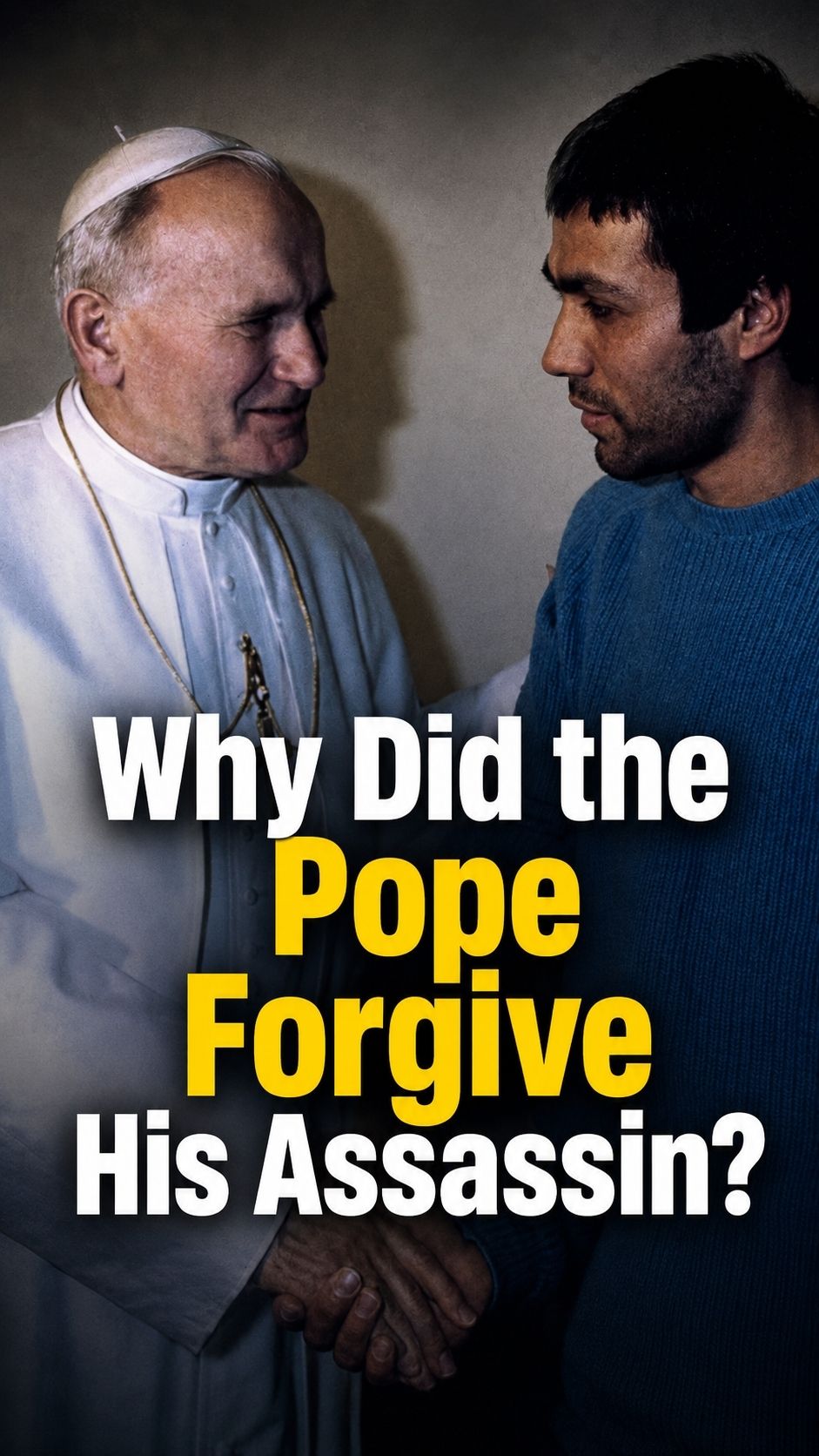
That is why the most famous images of the meeting show the two men sitting unusually close together, apparently speaking almost in whispers.
What exactly Ağca told John Paul II has never been publicly established.
The Pope deliberately kept it that way.
Afterward, he said that what had passed between them was something that should remain between the two of them.
But he did reveal what he had told Ağca about forgiveness.
“As Men and as Brothers”
Later that same day, John Paul II spoke about the meeting during his visit to the prison.
He recalled that Ağca had attempted to take his life on May 13, 1981, and explained that he had now been able to repeat directly to him the forgiveness he had already given immediately after the shooting.
Then he explained how he understood the encounter.
He said they had been given the opportunity to meet as men and as brothers.
For John Paul II, that language came directly from his Christian belief that human dignity does not disappear even when a person commits a terrible act. In his remarks at Rebibbia, he connected their shared humanity with the idea that all people were children of the same God.
The photographs from the prison therefore show more than an unusual meeting between an attacker and his victim.
They show the Pope deliberately confronting the implications of something he had been preaching publicly since the days immediately following the shooting.
He had said he forgave Ağca.
Now he sat beside him.
But Why Did Ağca Shoot the Pope?
This is where the story becomes much less clear.
Ağca initially maintained that he had acted alone. Later, he began claiming that the assassination attempt was part of a larger international conspiracy involving Bulgarian operatives and, ultimately, Soviet interests.
The theory attracted enormous attention during the Cold War.
There was an obvious geopolitical reason for suspicion. John Paul II was Polish, openly supportive of human rights behind the Iron Curtain and closely associated with the extraordinary rise of Poland’s Solidarity movement. Moscow had good reason to regard his influence in communist Eastern Europe with concern.
But suspicion is not proof.
Declassified U.S. government documents reveal how uncertain American officials themselves were.
A 1982 State Department intelligence assessment noted that Ağca had connections with Bulgarian nationals and had spent time in Sofia, but warned that he had already been caught lying repeatedly during the investigation.
By June 1984, another U.S. intelligence assessment concluded that the evidence for direct Bulgarian involvement remained inconclusive. Investigators could document suspicious contacts, but they could not establish that those contacts necessarily formed part of a plot to murder the Pope.
A separate CIA assessment from August 1984 similarly noted that Ağca’s credibility had been damaged by retractions and admitted falsehoods, even while analysts considered it possible that he had not acted entirely alone.
The issue eventually reached an Italian courtroom.
In 1986, three Bulgarian and several Turkish defendants accused of involvement in the conspiracy were acquitted because the evidence was insufficient to convict them. The lengthy proceedings failed to establish a proven Soviet-directed plot.
More than four decades later, Ağca’s precise motive and the question of whether someone ultimately stood behind him remain among the unresolved aspects of the case.
Ironically, the mystery surrounding the man who fired the gun makes the Pope’s decision more striking.
John Paul II forgave Ağca without first obtaining a satisfying explanation for why he had been shot.
Forgiveness Did Not Mean Freedom
There was another distinction in John Paul II’s position.
His personal forgiveness did not immediately free Ağca from the consequences of the crime.
Ağca remained imprisoned in Italy for nearly two decades.
Only in June 2000 did Italian President Carlo Azeglio Ciampi grant him a pardon. The Vatican welcomed the decision, and contemporary reports indicated that John Paul II had supported clemency for his attacker. Ağca was then extradited to Turkey, where he still faced imprisonment relating to the murder of Abdi İpekçi and other offenses.
The sequence is important.
John Paul II had forgiven Ağca in 1981.
He met him in 1983.
But Ağca remained behind bars until 2000.
The Pope’s forgiveness was therefore not a claim that justice had no place. It was a decision about his own relationship to the man who had attacked him.
The Image That Survived the Assassination
There are dramatic images from May 13, 1981: the white papal vehicle moving through the crowd, the confusion immediately after the shots, John Paul II collapsing into the arms of those around him.
Yet one of the defining images of the entire episode was taken two and a half years later.
There is no gun in it.
There is no crowd.
There are only two men sitting inside a prison.
One had raised a pistol in St. Peter’s Square and nearly ended the other’s life. The other had survived, recovered and eventually crossed Rome to sit beside him.
The mystery of why Mehmet Ali Ağca shot Pope John Paul II has never been completely resolved.
The reason the Pope went to see him is considerably clearer.
John Paul II believed that forgiveness was not something reserved for minor injuries or offered only when it was easy. If it meant anything, it also had to apply when forgiveness seemed most unreasonable.
On December 27, 1983, he walked into Rebibbia Prison and tested that belief against the man who had nearly killed him.
That is why, decades after the gunshots in St. Peter’s Square, the handshake remains almost as memorable as the assassination attempt itself.