The broadcast associated with KDKA became a landmark in American radio. Its importance was not simply that a voice traveled through the air. Engineers and amateurs had already done that. Westinghouse was showing how a regular service could create a public that wanted to buy receivers and keep listening.
From a garage to a factory
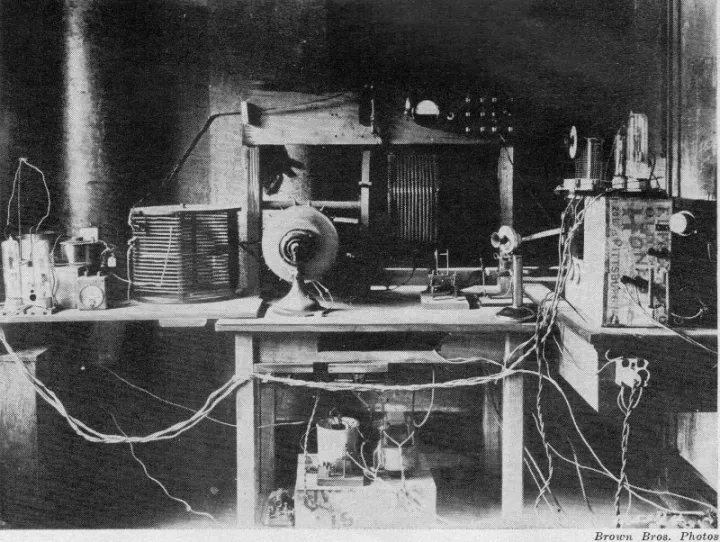
Frank Conrad supplied much of the technical experience. An engineer at Westinghouse, he operated amateur station 8XK from his home workshop in Wilkinsburg. His experiments developed an audience beyond the practical business of sending signals between operators. Records and other programming gave people a reason to listen when there was no message addressed personally to them.
Harry P. Davis saw the commercial opportunity. A company manufacturing radio equipment could also provide material worth receiving. Westinghouse built its new station at the East Pittsburgh works and chose election night for a public demonstration. An election had obvious advantages: the information was timely, the result mattered, and people could follow the returns together.
The details resist a tidy invention story. The KDKA Centennial account explains that the company’s October 27 license covered communications between its industrial plants. The election broadcast involved the special amateur call sign 8ZZ before KDKA became the familiar broadcasting identity. That distinction gets lost when an anniversary is reduced to a single sentence.
A microphone with a second life
The Smithsonian preserves the Westinghouse microphone associated with the broadcast. Nicknamed the “Tomato Can,” it adapted a telephone transmitter inside a suitable housing. Its museum record identifies it as the instrument used for the Harding–Cox election bulletins.
This was not a gleaming console from a mature entertainment industry. Radio drew on telephone components, workshop knowledge and improvised arrangements. The apparatus needed to turn speech into a usable signal; comfortable studios and familiar broadcasting routines could come later.
A Harris & Ewing photograph shows the microphone with Smithsonian scientific aide Fred C. Reed in 1938. That picture is valuable evidence of the object’s later preservation. It should not be dated 1920 merely because the equipment was used then. The gallery keeps that eighteen-year gap visible.
What happened after election night
The decisive step was repetition. Westinghouse continued broadcasting after the special program. Regular listening could become a habit, and receiving equipment could become a household purchase. The station’s early rooms, a new studio pictured in December 1922 and a 1925 appearance by Pittsburgh Pirates manager Bill McKechnie show different stages of that development.
The audience still required technology and practical help. The National Bureau of Standards tested radio materials and antennas, developed measuring standards and published advice for people building receivers. Commercial broadcasting depended on that less glamorous work as well as on the voices coming from a studio.
Growing numbers of stations also raised questions about the use of the airwaves. The Federal Judicial Center’s account places early radio within the legal disputes that accompanied broadcasting’s expansion. A technology that reached strangers across distance needed rules as well as transmitters.
How to describe the milestone
KDKA is often called the first commercial radio station, but “first” depends on what is being counted: experimental speech, a public program, a license, a continuing schedule or a commercial purpose. Other pioneers belong in those histories. November 2, 1920 is most useful as a date when an ambitious, sustained Westinghouse broadcasting venture made a memorable public appearance.
Harding won the election. Radio gained something different: a demonstration that people would gather around a receiver for news they could not yet see in print.
Cover photograph: Underwood & Underwood / Chicago Tribune, October 11, 1925, p. 62; Wikimedia Commons