Only thirty days separated the launch from Sputnik 1. The first satellite had established that the Soviet Union could place an object in orbit. The second carried a living passenger, making the prospect of human spaceflight much harder to dismiss.
The distinction that matters
Laika was the first animal to orbit Earth. She was not the first animal to reach space. Earlier rockets had carried animals on suborbital flights, rising above the atmosphere and then falling back without completing an orbit. Soviet dogs Tsygan and Dezik survived such a flight in July 1951.
Those earlier experiments addressed practical questions: whether an animal could withstand launch, how it would respond to weightlessness, and whether a pressurized cabin, parachutes and recovery equipment would work. American researchers were also sending animals aloft. The experiments supplied information for future human crews, sometimes at the cost of the animals’ lives.
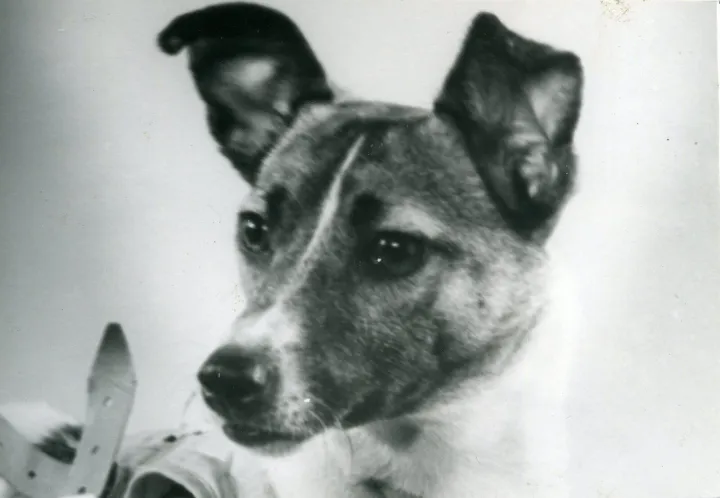
Laika had been a stray. NASA’s history of animal flights describes her as a small mongrel taken from the street and trained hurriedly for the mission. In later commemoration she became an emblem of the space age. Before that, she was a dog selected for an experiment whose outcome she could neither understand nor refuse.
A much heavier second satellite
Sputnik 2 weighed about 508 kilograms, roughly six times the mass of its predecessor. It carried the equipment needed to support and monitor Laika, along with scientific instruments. After reaching orbit, it remained attached to its booster. The mission was prepared quickly, following the tremendous attention given to the first satellite.
The engineering limits were severe. No recovery system had been provided, and the environmental controls were inadequate for a long flight. Modern NASA accounts say Laika probably survived only a few hours after reaching orbit. The Science Museum’s history identifies overheating as the cause of her death.
That brief survival must be separated from the spacecraft’s much longer existence. Sputnik 2’s batteries ran out on November 10, ending the receipt of its scientific data. The satellite stayed in orbit until April 14, 1958, when it burned up during reentry. Months in orbit did not mean months of life inside the cabin.
What the signals meant on Earth
In the United States, the two Sputnik launches turned a distant technological possibility into an urgent political concern. Soviet rockets could lift substantial payloads, and the second satellite suggested a route toward sending people into space. The reaction combined scientific interest, military anxiety and worry about national prestige.
The American response did not follow a smooth timetable. Vanguard’s December 1957 launch attempt failed on the pad. Explorer 1 reached orbit the following January. During 1958, the United States created NASA to lead its civilian space program. Laika’s mission was one event within that wider acceleration, rather than the sole cause of every decision that followed.
The dog beyond the symbol
Stamps issued in several countries helped turn Laika into an instantly recognizable figure. A small animal could carry the meaning of a large technological contest. Museum models later made the hardware visible to visitors who had known the mission mainly through photographs and printed accounts.
Nearly three years after Laika’s flight, Soviet animals returned safely from orbit. The technology had advanced to include something Sputnik 2 lacked: a return journey. Remembering November 3 means keeping both facts in view—the new knowledge gained in 1957, and the dog for whom reaching orbit was the end of any possibility of coming home.
Cover image: Museum of Cosmonautics / Main Archive of Moscow / Mos.ru; photographer unidentified