Eleven days of possibility
The revolt had begun on October 23 with demonstrations that became an armed confrontation. Its participants did not share a single program. Students, workers, soldiers and reform-minded Communists wanted different kinds of change, united by anger at repression and Soviet domination. Street fighting and the emergence of revolutionary councils unsettled a state that had appeared firmly within Moscow’s control.
Nagy returned to the premiership and moved beyond limited reform. Political parties reappeared, and the government announced an end to the one-party system. On November 1, Nagy declared Hungarian neutrality and withdrawal from the Warsaw Pact. For people who had fought in the streets, these were tangible gains. For the Soviet leadership, they threatened the strategic and political order of Eastern Europe.
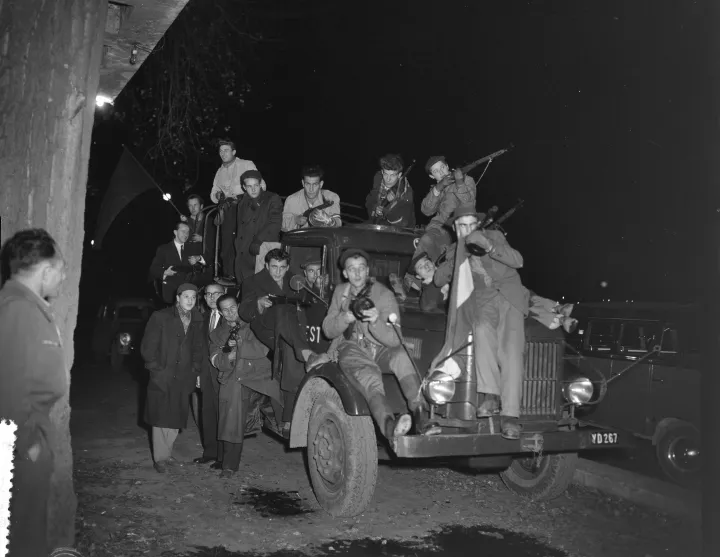
Photographs taken on November 2 still show armed revolutionaries moving around Budapest in a truck. The men knew that weapons mattered. They could not know precisely when or how the Soviet leadership would close the opening that the uprising had created.
The second Soviet assault
Soviet troops had already intervened during the uprising’s first phase. The November 4 operation was a larger effort to impose a government acceptable to Moscow. Tanks and troops struck the capital while János Kádár announced a new government backed by Soviet power. Nagy’s appeal could reach foreign listeners; it could not summon an army capable of saving his administration.
At 5:20 a.m., Nagy broadcast that Soviet troops were attacking Budapest. He subsequently took refuge at the Yugoslav embassy. Fighting continued in several districts and industrial areas after the government ceased functioning. The resistance at Csepel lasted until November 11. The familiar statement that the revolution was crushed on November 4 names the decisive intervention, not the instant disappearance of opposition.
Help from abroad had limits
The intervention coincided with the Suez crisis, in which Britain, France and Israel had attacked Egypt. The two crises crowded the same diplomatic agenda. Yet Western unwillingness to fight the Soviet Union over Hungary cannot be explained by distraction alone. Hungary lay inside the Soviet military sphere, and intervention risked a far wider war.
The United States condemned the attack. At the United Nations, Soviet obstruction prevented the Security Council from securing a withdrawal; appeals from the General Assembly did not change control on the ground. Hungarians who had hoped that outside pressure would become outside rescue faced a brutal gap between expressions of support and available power.
Defeat, flight and unfinished protest
About 200,000 people fled Hungary, most crossing into Austria and others into Yugoslavia. Reception centers, transport and resettlement became an international undertaking. UNHCR’s account of the emergency records a response that sent refugees onward to countries across the world. Leaving was itself a profound consequence of the intervention: families and careers were rebuilt far from the streets where the revolt had begun.
Inside Hungary, strikes and demonstrations outlasted the main fighting. On December 4, women marched in Budapest one month after the Soviet assault. Nagy, meanwhile, had been arrested after leaving the Yugoslav embassy despite assurances of safe conduct. He was executed in June 1958.
The Soviet-backed government survived. The revolution’s demands survived differently—in exile communities, private memory and later public commemorations. November 4 marks the moment Moscow restored control by force, along with the beginning of the much longer struggle over what Hungary’s defeated revolution would mean.
Cover photograph: Joop van Bilsen / Anefo, Nationaal Archief, 908-1191. CC0.