
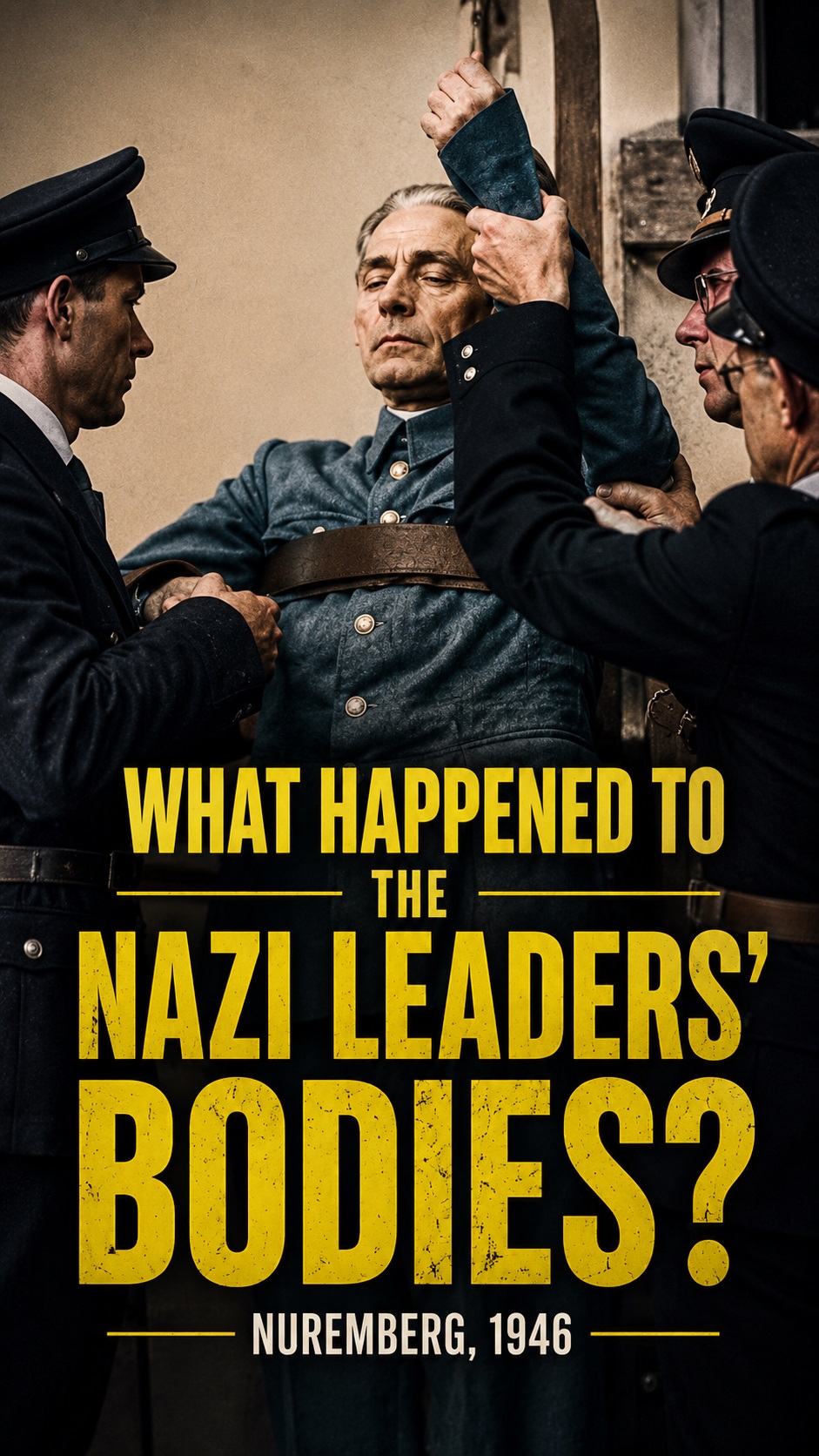
In the early hours of October 16, 1946, ten of the most prominent surviving figures of Nazi Germany were led one by one to the gallows inside Nuremberg Prison.
Their trial had lasted almost a year. The International Military Tribunal had heard evidence of aggressive war, mass murder, forced labor, persecution, deportation and crimes committed across occupied Europe. Now the first and most famous Nuremberg Trial had reached its final act.
But the executions created another problem—one that had little to do with law and everything to do with memory.
What should be done with the bodies?
The Allied authorities did not want Joachim von Ribbentrop, Wilhelm Keitel, Ernst Kaltenbrunner, Alfred Rosenberg, Hans Frank, Wilhelm Frick, Julius Streicher, Fritz Sauckel, Alfred Jodl or Arthur Seyss-Inquart to receive conventional graves.
Nor did they want a grave for Hermann Göring, the highest-ranking Nazi defendant at Nuremberg, who escaped the gallows by committing suicide only hours before the executions.
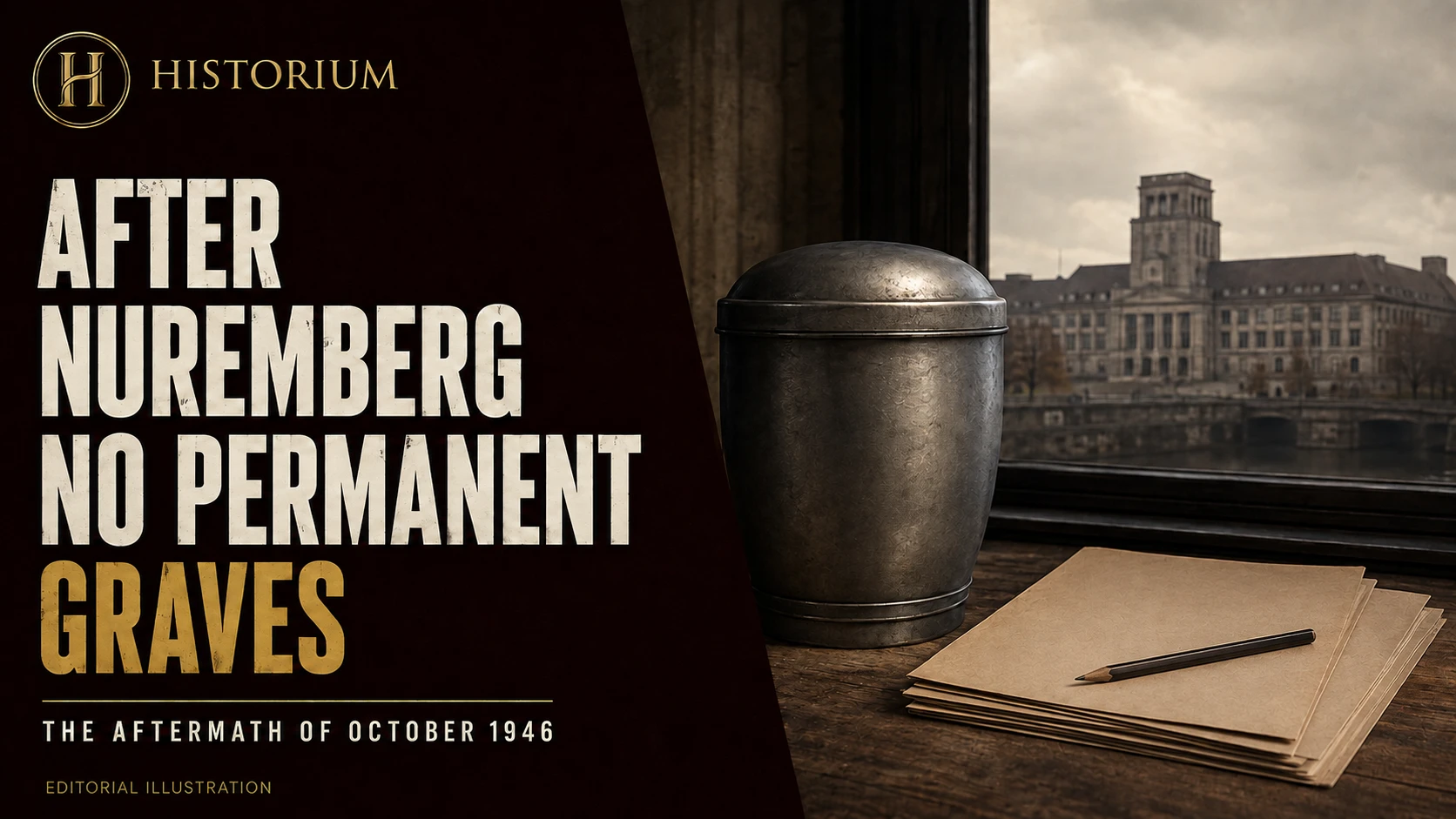
The solution was deliberate: there would be no public funerals, no identifiable burial places and no permanent graves around which Nazi sympathizers could gather.
Their bodies would disappear.
From the Third Reich to the Defendant's Dock
The International Military Tribunal formally opened in Nuremberg on November 20, 1945. The United States, United Kingdom, Soviet Union and France each supplied judges and prosecution teams.
Twenty-four leading Nazi officials had originally been indicted. They represented different parts of the regime's political, military, diplomatic and economic leadership.
The charges included conspiracy to commit crimes against peace, crimes against peace, war crimes and crimes against humanity. The prosecution relied heavily on captured German documents, photographs and films—much of the evidence having been produced by the Nazi state itself.
The choice to hold a trial at all was significant.
During the war and its immediate aftermath, Allied leaders had debated how the surviving leadership of Nazi Germany should be punished. Summary execution had been discussed. Instead, the defendants would be confronted with evidence, represented by lawyers and judged before an international tribunal.
On October 1, 1946, the verdicts were delivered.
Nineteen defendants were convicted and three were acquitted. Twelve received death sentences.
But only ten would ultimately reach the gallows.
The Twelve Death Sentences
The Tribunal sentenced the following men to death:
Martin Bormann — sentenced in absentia. His whereabouts were unknown at the time.
Hermann Göring — Reichsmarschall, former head of the Luftwaffe and the most senior surviving Nazi leader on trial.
Joachim von Ribbentrop — Nazi Germany's foreign minister.
Wilhelm Keitel — chief of the Armed Forces High Command.
Ernst Kaltenbrunner — senior SS official and head of the Reich Security Main Office.
Alfred Rosenberg — one of the regime's principal racial and ideological theorists.
Hans Frank — Governor-General of occupied Poland.
Wilhelm Frick — former Reich Interior Minister.
Julius Streicher — founder and publisher of the violently antisemitic newspaper Der Stürmer.
Fritz Sauckel — responsible for the mobilization of millions of forced laborers for the German war economy.
Alfred Jodl — senior officer in the German Armed Forces High Command.
Arthur Seyss-Inquart — senior Nazi official who played major roles in Austria and the occupied Netherlands.
Martin Bormann could not be executed because he was absent. It was only decades later that evidence conclusively established that he had died while attempting to escape Berlin during the final days of the war.
That left eleven condemned men inside Allied custody.
Then, on the night before the executions, there were only ten.
Hermann Göring's Final Defiance
Hermann Göring had been the dominant personality among the defendants.
Once one of the most powerful men in Nazi Germany, Göring had served as commander of the Luftwaffe and for years stood near the top of Hitler's regime. At Nuremberg he remained openly defiant, defended much of his political record and showed little remorse.
The Tribunal found him guilty on all four counts and sentenced him to death by hanging.
But Göring had no intention of allowing the Allies to execute him.
On the night of October 15, only hours before he was due to be taken to the gallows, he swallowed cyanide in his prison cell.
The precise story of how Göring obtained the poison has never been established beyond doubt. Despite close surveillance and searches intended to prevent suicide, he somehow retained or acquired access to a cyanide capsule.
When guards realized what had happened, the highest-ranking Nazi at Nuremberg was already beyond the reach of the executioner.
Göring had avoided hanging.
He had not, however, avoided the fate planned for the bodies of the other condemned men.
His remains would eventually accompany theirs.
The Executions of October 16, 1946
The remaining death sentences were carried out during the early hours of October 16.
The execution chamber was not in Courtroom 600, where the world had watched the trial. The gallows had instead been constructed inside the old gymnasium on the grounds of Nuremberg Prison.
One after another, the ten condemned men were brought into the room and hanged.
Joachim von Ribbentrop, Wilhelm Keitel, Ernst Kaltenbrunner, Alfred Rosenberg, Hans Frank, Wilhelm Frick, Julius Streicher, Fritz Sauckel, Alfred Jodl and Arthur Seyss-Inquart all died that night.
The executions ended the judicial process against the men sentenced to death.
Yet the Allies had already considered what would happen next.
Allowing the families to bury the bodies in conventional graves created a political risk. These were not anonymous criminals. Their names had been embedded for years in Nazi propaganda and in the machinery of the Third Reich.
A marked grave could become something more than a burial place.
It could become a symbol.
The Problem of the Graves
Political movements often construct memory around physical locations.
Birthplaces, battlefields, prisons, monuments and graves can all become destinations for followers long after the people associated with them are dead.
The Allied authorities had good reason to understand this problem.
The collapse of Nazi Germany did not mean that Nazi ideology had vanished overnight. Millions of Germans had lived under the regime for twelve years. Nazi organizations had penetrated political, military, educational and social life. Former Party members remained throughout postwar German society.
A grave belonging to Göring, Ribbentrop, Streicher or another prominent Nazi could therefore become a place where admirers gathered, commemorated the dead or attempted to transform convicted war criminals into political martyrs.
The disposal of the bodies was consequently treated not merely as a funeral matter, but as a question of postwar security and political memory.
There would be no mausoleums.
No official headstones.
No recognizable resting places.
And no location that could easily be turned into a shrine. Historical accounts of Allied policy describe the secrecy surrounding the disposal as specifically intended to prevent glorification or martyrdom.
The Secret Journey to Munich
After the executions, the bodies were removed from Nuremberg.
They were transported approximately 170 kilometers south to Munich.
The destination was the crematorium at the Ostfriedhof, Munich's Eastern Cemetery.
The choice meant that the bodies would not remain anywhere near the courtroom, prison or city where the Nazi leadership had been publicly judged.
The operation was conducted discreetly. Göring's corpse was disposed of alongside those of the ten men who had been hanged.
According to the Memorium Nuremberg Trials—the museum and documentation center located at the historic site of the trials—the bodies were transported to Munich and cremated in the Ostfriedhof crematorium.
The secrecy served a practical purpose.
Once cremation was complete, there would be no body to recover, no coffin to exhume and no identifiable grave.
But there was still one final problem.
The ashes themselves.
The Ashes and the Isar
The cremated remains were not given to the families.
They were not placed in urns bearing the men's names.
They were not interred in a cemetery.
Instead, the ashes were removed and scattered into a tributary of the Isar River near Munich. The official Memorium Nuremberg Trials specifically records that the ashes were scattered in a tributary of the Isar.
The exact symbolism is difficult to separate from the practical purpose.
Water leaves no fixed grave.
There is no stone to visit.
No coordinates to turn into a pilgrimage site.
No physical remains around which a mythology can easily be constructed.
The men who had once occupied ministries, military headquarters and enormous public stages within the Third Reich were deliberately denied one of the most basic forms of historical permanence: a marked resting place.
Their names remained in the historical record.
Their crimes remained documented in millions of pages of evidence.
But their bodies disappeared.
Why the Location Mattered
The disposal of Nazi leaders after Nuremberg was part of a much broader struggle over how postwar Europe would deal with the physical legacy of National Socialism.
The Third Reich had relied heavily on spectacle.
Architecture, monuments, mass rallies, banners, uniforms and political rituals had been essential parts of Nazi propaganda. Nuremberg itself had been one of the regime's most important ceremonial cities, famous for the enormous Nazi Party rallies held there before the war.
After 1945, the Allies faced the opposite problem: how to prevent the remains of the defeated dictatorship from becoming raw material for a new political cult.
The treatment of the executed leaders' bodies therefore carried a message.
Their crimes would be documented.
Their trials would be recorded.
Their names would remain part of history.
But they would not be given monuments.
This distinction was fundamental.
Erasing evidence of Nazi crimes would have served denial. Preserving evidence while denying the perpetrators sites of glorification served a different purpose entirely.
Nuremberg was designed to leave behind a judicial record rather than a martyr cult.
A Policy Vindicated Decades Later
The concern about Nazi graves becoming gathering places was not theoretical.
Rudolf Hess provides a striking later example.
Hess, Hitler's former deputy, was sentenced at Nuremberg to life imprisonment rather than death. He spent decades in Spandau Prison and died there in 1987.
Unlike the executed defendants, Hess was buried in a family grave in Wunsiedel, Bavaria.
The grave subsequently became a destination for neo-Nazi commemorations. Annual marches connected with Hess drew extremists to the town and repeatedly created political and security problems.
Eventually, in 2011, the lease on the grave was terminated with the agreement of the family. Hess's remains were exhumed, cremated and his ashes dispersed.
More than six decades after Nuremberg, the controversy surrounding Hess demonstrated precisely why Allied officials had been reluctant to leave the executed Nazi leadership identifiable graves in 1946.
Physical burial sites can acquire political lives of their own.
No Grave, But No Erasure
There is an important distinction between denying the Nazi leaders graves and attempting to erase them from history.
The Allies did not destroy the documentary record of their lives.
Quite the opposite.
The Nuremberg proceedings created one of the most extensive public records ever assembled concerning the leadership of a defeated regime. Court transcripts, captured German documents, photographs, films, witness testimony and judicial decisions were preserved.
The defendants were denied monuments, but they were not removed from the historical record.
Their actions could still be studied.
Their responsibility could still be debated and examined.
Their crimes could still be documented.
What disappeared was the possibility of a physical grave becoming a substitute for history.
That may be the most important aspect of what happened after the executions.
The destruction of the bodies was not intended to make the men anonymous.
Their names were already too deeply connected to the crimes of Nazi Germany for that.
Instead, the Allies separated historical memory from physical commemoration.
The record would remain.
The shrine would not.
The Final Journey
On November 20, 1945, the surviving leadership of Nazi Germany entered the courtroom at Nuremberg as defendants.
On October 1, 1946, twelve were sentenced to death.
Hermann Göring killed himself before his sentence could be carried out. Martin Bormann had been tried in absentia.
In the early hours of October 16, the remaining ten condemned men were hanged.
Their bodies, together with Göring's, were taken away from Nuremberg and transported to Munich. At the Ostfriedhof crematorium, their physical remains were reduced to ashes.
Those ashes were then scattered into a tributary of the Isar.
There were no public funerals.
No permanent headstones.
No graves.
For men who had belonged to a regime obsessed with monuments, ceremony and its own place in history, the ending was deliberately without one.
Their names survived because history recorded what they had done.
Their graves did not.