The result is often reduced to a simple explanation: Theodore Roosevelt split the Republican vote and handed Wilson the election. The split certainly helped. It also grew out of a substantial argument about what government should do in an industrial society, and who had the authority to speak for the Republican Party.
A successor becomes an opponent
Roosevelt had supported William Howard Taft as his successor in 1908. By 1912, the relationship had broken down. Roosevelt believed Taft had retreated from the reforming direction of his presidency. Taft and his supporters saw the former president's challenge differently, as a threat to the party and to their understanding of constitutional government.
The Republican convention kept Taft as its nominee. Roosevelt's supporters refused to accept that outcome as the last word. They organized the Progressive Party, soon widely known by its Bull Moose nickname, and nominated Roosevelt with California governor Hiram Johnson. An election that might have been a conventional contest between two parties became a fight involving two rival Republican traditions.
Different meanings of reform
Wilson, the governor of New Jersey, had received the Democratic nomination on July 2. His New Freedom program emphasized competition, stronger antitrust action and lower tariffs. He argued that concentrated economic power could be challenged by removing privileges and opening markets to smaller enterprises.
Roosevelt's New Nationalism assigned a larger supervisory role to the federal government. Large businesses were a fact of modern life; the task was to regulate their conduct in the public interest. Social protections and stronger national authority belonged within that program. Wilson and Roosevelt both spoke as reformers, but their descriptions of the problem pointed toward different remedies.
Eugene V. Debs offered another answer. Running for the Socialist Party with Emil Seidel, he challenged the economic system more fundamentally. His presence matters because the election was not simply a family quarrel between Roosevelt and Taft. More than 900,000 voters chose the Socialist ticket, around six percent of the popular vote.
A large victory with a divided electorate
Wilson received approximately 41.8 percent of the popular vote. Roosevelt followed with 27.4 percent and Taft with 23.2 percent. Roosevelt won 88 electoral votes. Taft received only eight, from Utah and Vermont. Debs received none. The distribution shows how a candidate could win a commanding electoral majority while most voters collectively preferred someone else.
One detail complicates even the official tally. Taft's running mate, Vice President James Sherman, died shortly before the election. When electors voted afterward, the eight Republican vice-presidential votes went to Nicholas Murray Butler instead. A table listing Butler therefore records the electoral vote, not the ticket as it had been presented during most of the campaign.
Congress counted the votes on February 12, 1913. The surviving tally converts a noisy campaign into columns and totals, but the numbers still carry its unusual shape: an incumbent finishing third, a former president leading a new party, and a Democrat winning the White House with a plurality. Wilson had secured the office. The disagreements about corporate power, competition and federal responsibility were going there with him.
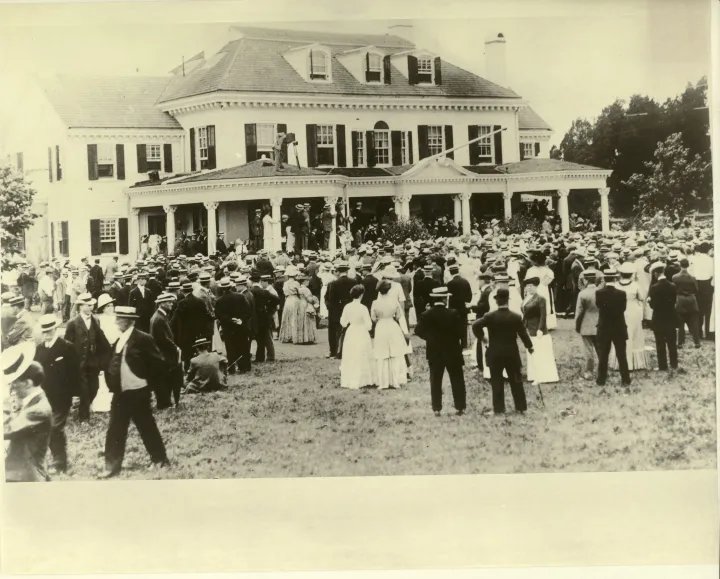
Cover image: Unknown photographer / Woodrow Wilson Presidential Library Archives, accession 1832; source Princeton University Library · No known copyright restrictions