
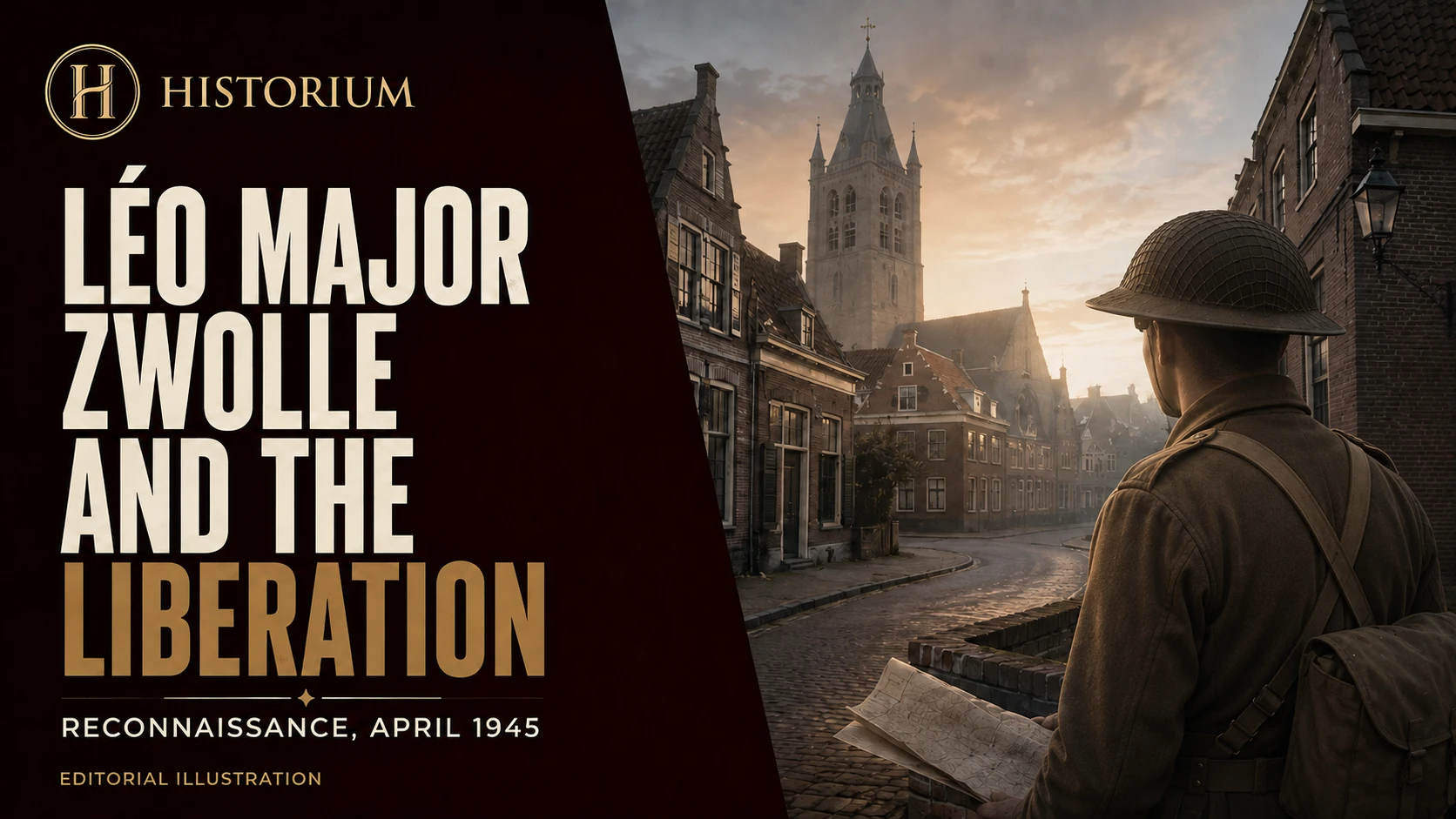

Léo Major’s place in Zwolle’s memory is secure. Explaining what he did there requires more care than the familiar claim that one soldier liberated an entire city. The strongest account brings individual courage into focus while keeping the other people in the scene: a fellow scout who died, Dutch residents and resistance members, and Canadian units advancing toward the town.
The distinction does not make the night of 13–14 April 1945 less significant. It changes the measure of achievement. Obtaining reliable information and bringing it back to a commander could influence how troops entered a city. A successful reconnaissance mission could matter precisely because it helped avoid further fighting.
A soldier before he became a symbol
Major was born in Massachusetts in 1921 to French Canadian parents and grew up in Montréal. He enlisted in 1940, trained in Canada and Britain, and landed in Normandy on D-Day. Veterans Affairs Canada outlines his early life and service.
These basic details situate him within a military generation. The scout approaching Zwolle had already spent years in uniform. Recognising that preparation provides a more useful explanation of his ability to act under pressure than treating him as someone who suddenly became effective through anger alone. His individuality mattered within a career of training and service.
The patrol of 13–14 April
Major and Corporal Willy Arsenault set out on reconnaissance on 13 April. Arsenault was killed near the town, and Major continued. The DCM citation reproduced by the Juno Beach Centre describes contact with the underground, the organisation of local Dutch patrols, and pressure on the German garrison from inside and outside. The museum’s account includes that passage from the award citation.
Several relationships are visible even in that concise record. Major began with a companion; Dutch people participated after he reached the town; other Allied forces were outside it. Continuing after the loss of a fellow scout was an individual act of determination. Completing a mission through contact with local people was also a cooperative achievement.
Reconnaissance has an outcome that is easy to overlook in a dramatic retelling: knowledge. Whether a position remains occupied, where the enemy is located and whom an advancing unit can contact all affect a commander’s choices. A scout who returns with a dependable answer has done more than survive a dangerous journey.
The army beyond the city streets
C. P. Stacey’s official Canadian Army history places Zwolle within the 3rd Canadian Division’s northern advance. It credits the 7th Brigade with occupying the town and explicitly identifies Major’s dangerous reconnaissance as assistance that earned the Distinguished Conduct Medal. His regiment was temporarily under that brigade’s command. The Victory Campaign gives this account on page 556.
That operational scale matters. Soldiers in a town respond to the surrounding military situation as well as to what happens directly in front of them. A garrison’s withdrawal cannot automatically be explained by a single encounter, especially when an army is advancing nearby. Preserving the larger movement makes it possible to understand why information from inside Zwolle could be useful outside it.
It also prevents a false choice between remembering one soldier and remembering his formation. An official history can name an individual’s contribution while describing the unit’s role. Those are complementary levels of explanation, each revealing something the other cannot.
What the medal recognises
The Distinguished Conduct Medal was a major gallantry award for ranks below commissioned officers, ranking immediately after the Victoria Cross in that category. The Canadian War Museum explains its purpose.
An award citation is evidence of what military authorities formally recognised. It is not an exhaustive record of every movement or conversation, and it should not be expanded into scenes that it does not describe. Its value lies in identifying the actions and qualities selected for recognition, rather than functioning as permission to add increasingly spectacular details.
This is particularly important when discussing an individual award arising from a shared operation. The medal singles out the recipient. It does not establish that nobody else contributed to the result.
The story grew after the war
In a 2025 Canadian Military Journal study, historian John MacFarlane contrasts the documented reconnaissance with later stories of an isolated, furious gunman conquering Zwolle street by street. He also cites the regiment’s 14 April diary: Major returned with news that the enemy had left, after which the commander ordered companies into the city. MacFarlane discusses the evidence and the changing legend on pages 62–64.
This leaves a clear editorial boundary. Major’s courage can be described without asserting that every later anecdote is independently confirmed. Exact dialogue, elaborate prisoner totals and a detailed sequence of supposed firefights require evidence beyond the popularity of the story.
Looking at Zwolle’s people
ANNO, Zwolle’s city museum, identifies a photograph of Major with named residents on 14 April 1945. Its account also catalogues local amateur footage of civilians welcoming Canadian soldiers and moving through the streets during liberation. The museum supplies names, dates and archival context.
Those descriptions offer another way to approach the event. The people around the soldier are historical participants with names, homes and relationships. Their presence broadens the story from a patrol to a city experiencing the end of occupation. Preserving the caption helps keep them from becoming an anonymous backdrop to someone else’s biography.
Zwolle’s municipal honours register records an award to Major in 1985 and honorary citizenship in 2005. Its explanation presents him as a lasting symbol of freedom and friendship. The city’s register documents that recognition.
A symbol can carry gratitude across generations without being a literal description of everything that happened. Remembering Major alongside Arsenault, local resistance members, residents and Canadian troops honours the event more fully. The achievement remains remarkable when its human connections are restored.