

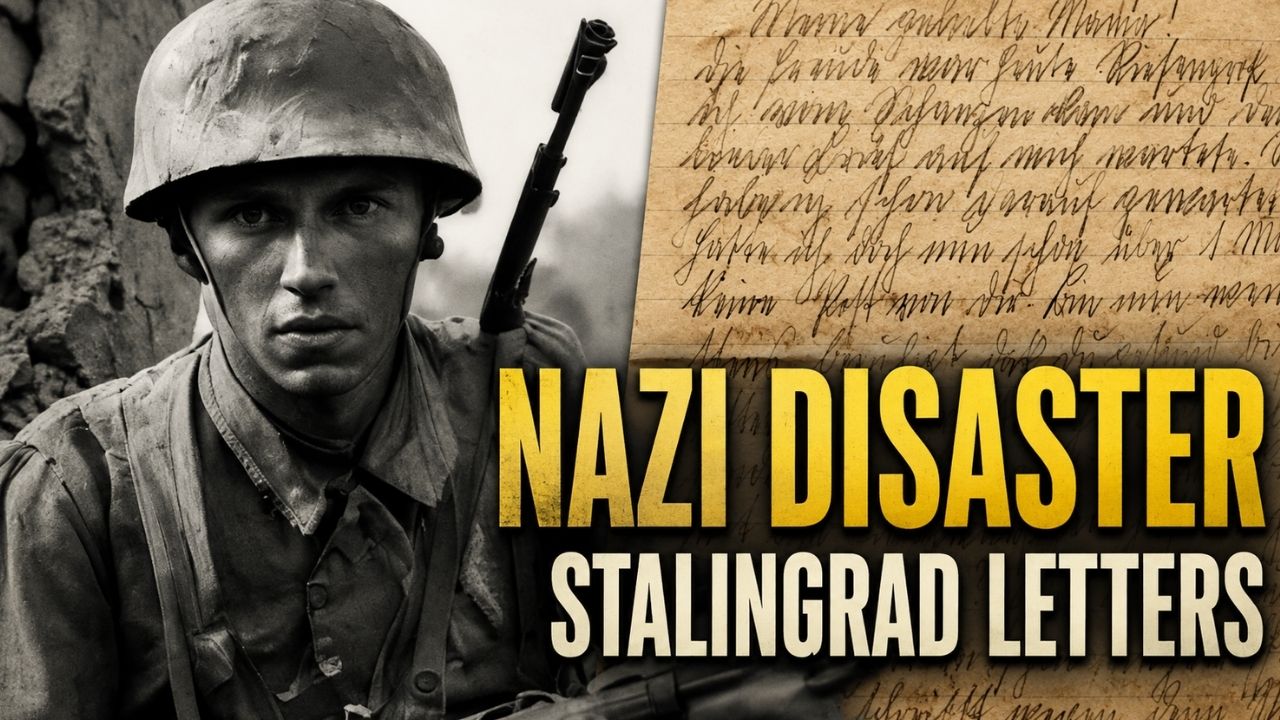
Military history often reduces battles to arrows on maps. Divisions advance, defensive lines collapse, cities change hands and casualty figures accumulate until events of almost unimaginable human scale become understandable diagrams.
Stalingrad resists that simplification.
Between the summer of 1942 and February 1943, the city on the Volga became the center of one of the most destructive confrontations of the Second World War. German forces reached the city expecting another victory in a campaign that had already carried the Wehrmacht across enormous areas of the Soviet Union. Months later, the German Sixth Army no longer existed as an effective fighting force. Its commander, Field Marshal Friedrich Paulus, was a prisoner, tens of thousands of his soldiers were dead, and roughly 91,000 surviving Axis troops had entered Soviet captivity.
Yet some of the most haunting traces of Stalingrad are not military orders or operational maps. They are letters.
They remind us that inside the enormous machinery of the battle were individual men who were hungry, frightened, freezing and increasingly aware that they might never see their families again.
The Road to the Volga
The disaster at Stalingrad cannot be understood without the failure of Germany’s original plan for the Soviet Union.
Operation Barbarossa began on June 22, 1941. German and allied forces initially achieved enormous territorial gains, destroyed or captured large Soviet formations and advanced toward Leningrad, Moscow and Ukraine. But the Soviet state did not collapse. German logistics were stretched across enormous distances, resistance intensified, and the Wehrmacht failed to take Moscow before winter.
The following year Hitler shifted the main German effort south.
Oil was central to the strategy. Germany’s war economy required enormous quantities of fuel, while the Caucasus contained some of the Soviet Union’s most important petroleum resources. The 1942 summer campaign therefore pushed toward the Caucasus and the lower Volga. Stalingrad stood along that wider axis of advance. Its factories were important, the Volga was a major transport artery, and the city carried Joseph Stalin’s name, giving its capture obvious propaganda value.
General Friedrich Paulus’s Sixth Army approached Stalingrad during the summer of 1942. On August 23, German forces reached the Volga north of the city while Luftwaffe bombing devastated large sections of Stalingrad. The destruction that was expected to weaken Soviet resistance instead created an environment exceptionally well suited to defense.
When the Rubble Became a Fortress
The German Army had developed a devastating style of mobile warfare. Tanks, motorized formations, artillery and aircraft had repeatedly broken opposing armies before they could establish stable defensive fronts.
Stalingrad deprived the Germans of many of those advantages.
The battle became increasingly fragmented. Soldiers fought through factories, houses, basements, staircases, courtyards and piles of rubble. Positions could be separated by a street, a floor of the same building or even a wall. Territory that appeared trivial on a strategic map could require days of fighting and heavy casualties to capture.
General Vasily Chuikov, commander of the Soviet 62nd Army, deliberately kept his troops extremely close to German positions. The closer the two sides were, the more difficult it became for German aircraft and heavy artillery to attack Soviet positions without risking German troops as well.
Meanwhile, the Volga remained the Soviet defenders’ lifeline. Reinforcements, ammunition and supplies crossed the river, often under German fire, while wounded soldiers were evacuated in the opposite direction. Soviet positions along the western bank were repeatedly reduced to narrow strips of devastated ground, but the Germans never succeeded in completely eliminating them.
Civilians were also trapped inside this battlefield. Large numbers remained in Stalingrad as bombardment and close combat transformed residential districts into combat zones. Their experience is one reason the battle cannot be understood purely as a confrontation between armies.
Operation Uranus: Attacking the Flanks
By November, the German Sixth Army had committed enormous resources to the struggle inside Stalingrad.
But the forces protecting its flanks were considerably more vulnerable.
Romanian and other Axis formations held long stretches of the front north and south of the city. Soviet planners recognized that attacking these positions offered a far greater opportunity than continuing to batter directly against the strongest German formations inside Stalingrad.
On November 19, 1942, the Red Army launched Operation Uranus.
Soviet forces attacked north of the city, followed by another major attack from the south. The Axis flanks collapsed under the weight of the offensive. Soviet armored and mechanized forces drove rapidly into the German rear rather than turning toward the city itself.
On November 23, the northern and southern Soviet spearheads linked up near Kalach. The strategic trap was closed.
The German Sixth Army, along with other Axis units around Stalingrad, was now isolated inside an enormous pocket.
Hitler’s Order to Stay
Encirclement did not automatically mean destruction.
A rapid German breakout might still have saved a substantial portion of the army during the early stages of the crisis. Paulus and other commanders understood the danger. Hitler, however, refused to abandon Stalingrad.
The Sixth Army was ordered to hold its positions.
Hermann Göring then assured Hitler that the Luftwaffe could supply the pocket by air. The promise was disastrously unrealistic. An army of hundreds of thousands of men required enormous quantities of food, fuel, ammunition, medical supplies and other material every day. Aircraft could deliver only a fraction of what was needed, while weather, Soviet fighters, anti-aircraft defenses and the loss of airfields steadily reduced the airlift’s effectiveness.
Winter transformed a military crisis into a human catastrophe.
Food rations collapsed. Fuel disappeared. Ammunition became increasingly scarce. Thousands of wounded men filled improvised hospitals and cellars. Disease spread through troops already weakened by starvation and cold.
Attempts to relieve the pocket from outside failed. The Soviet ring tightened.
For the soldiers inside Stalingrad, the abstract language of military operations was increasingly replaced by a much simpler calculation: whether they would survive another day.
The Letters From the Pocket
German military mail—Feldpost—was one of the most important connections between soldiers and home throughout the war.
Letters could contain ordinary details about food, family, weather and daily routines, but they also preserved emotions that rarely appeared in official reports. Fear, exhaustion, homesickness, anger and doubt could enter a letter in ways they could never enter a propaganda newsreel.
That makes Stalingrad’s surviving correspondence historically valuable.
But an important distinction is necessary.
The famous postwar collection Last Letters from Stalingrad, first published in West Germany in 1950, has often been presented as a group of final letters intercepted by German authorities after being flown out of the pocket. According to the traditional story, the letters were examined to measure morale and were considered unsuitable for publication inside Nazi Germany.
Historians have, however, questioned the provenance and authenticity of that particular anthology. Scholars have noted difficulties with its sources, stylistic similarities between supposedly different writers and the inability to trace many texts back to identifiable archival originals. One academic discussion describes the authenticity of the collection as being in serious doubt.
This does not mean that German soldiers at Stalingrad did not write home. Genuine wartime Feldpost survives in archives and private collections, and soldiers throughout the Eastern Front continued corresponding with their families whenever military circumstances allowed.
The distinction matters: the historical reality of soldiers writing from a collapsing army is unquestioned; individual dramatic quotations attributed to the anonymous 1950 collection should be treated with greater caution unless they can be connected to an original document.
That caution does not diminish the human meaning of the correspondence. If anything, it makes genuine surviving letters even more important.
An Army Slowly Disintegrating
By January 1943, the Sixth Army was no longer capable of meaningful recovery.
Soviet forces began the final reduction of the pocket. German-held territory contracted, units became fragmented and the remaining airfields were lost. Paulus repeatedly confronted a military situation with no realistic prospect of victory.
Hitler nevertheless demanded continued resistance.
On January 30, Paulus was promoted to Field Marshal. The implication was difficult to miss. No German field marshal had previously surrendered, and Hitler expected Paulus to understand what tradition supposedly demanded of him.
Paulus refused that expectation.
On January 31, 1943, he surrendered in the southern part of the pocket. The remaining German forces in the northern sector continued fighting for another two days. On February 2, organized resistance ended.
Approximately 91,000 exhausted Axis soldiers entered captivity at the end of the battle. Starvation, disease, wounds and the brutal conditions of captivity killed many of them. Only a small proportion ultimately returned home years later.
The Sixth Army—one of the most powerful formations in the Wehrmacht—had been destroyed.
Why Stalingrad Mattered
Stalingrad did not by itself defeat Nazi Germany.
The war in Europe continued for more than two additional years, and the Wehrmacht remained capable of launching major operations after February 1943. The Germans would even regain the initiative temporarily around Kharkiv shortly after the Stalingrad surrender.
But something fundamental had changed.
The destruction of an entire German field army demonstrated that the Wehrmacht could not only be stopped but surrounded and annihilated. The victory transformed Soviet morale and had a profound psychological effect across occupied Europe. Contemporary anti-Nazi movements interpreted the news as evidence that Hitler’s empire was not invincible.
Strategically, the wider balance on the Eastern Front was also shifting. The U.S. Army’s official histories identify Stalingrad as the point at which the German position in the East moved into an increasingly defensive phase and the Soviet Union gained the initiative that would ultimately carry the Red Army westward.
The route from Stalingrad to Berlin would still be extraordinarily long and bloody.
But it had begun.
Beyond the Maps
The Battle of Stalingrad can be explained through logistics, operational mistakes, industrial geography, leadership decisions and the movement of armies.
All of those things matter.
But letters force the story down to a different scale.
A military map can show the Sixth Army surrounded by a red line. It cannot show what that circle meant to a man who had not eaten properly for days, whose hands were damaged by frostbite, who was thinking about his wife or children, and who understood that no relief might ever arrive.
That is why wartime correspondence remains so powerful.
The battle destroyed the German Sixth Army. The letters—when securely authenticated and placed in their proper historical context—help reveal what that destruction meant to the human beings trapped inside it.
And that may be the most enduring way to understand Stalingrad: not simply as the place where an army disappeared, but as the place where the language of triumph finally collided with the private language of fear, exhaustion and defeat.